
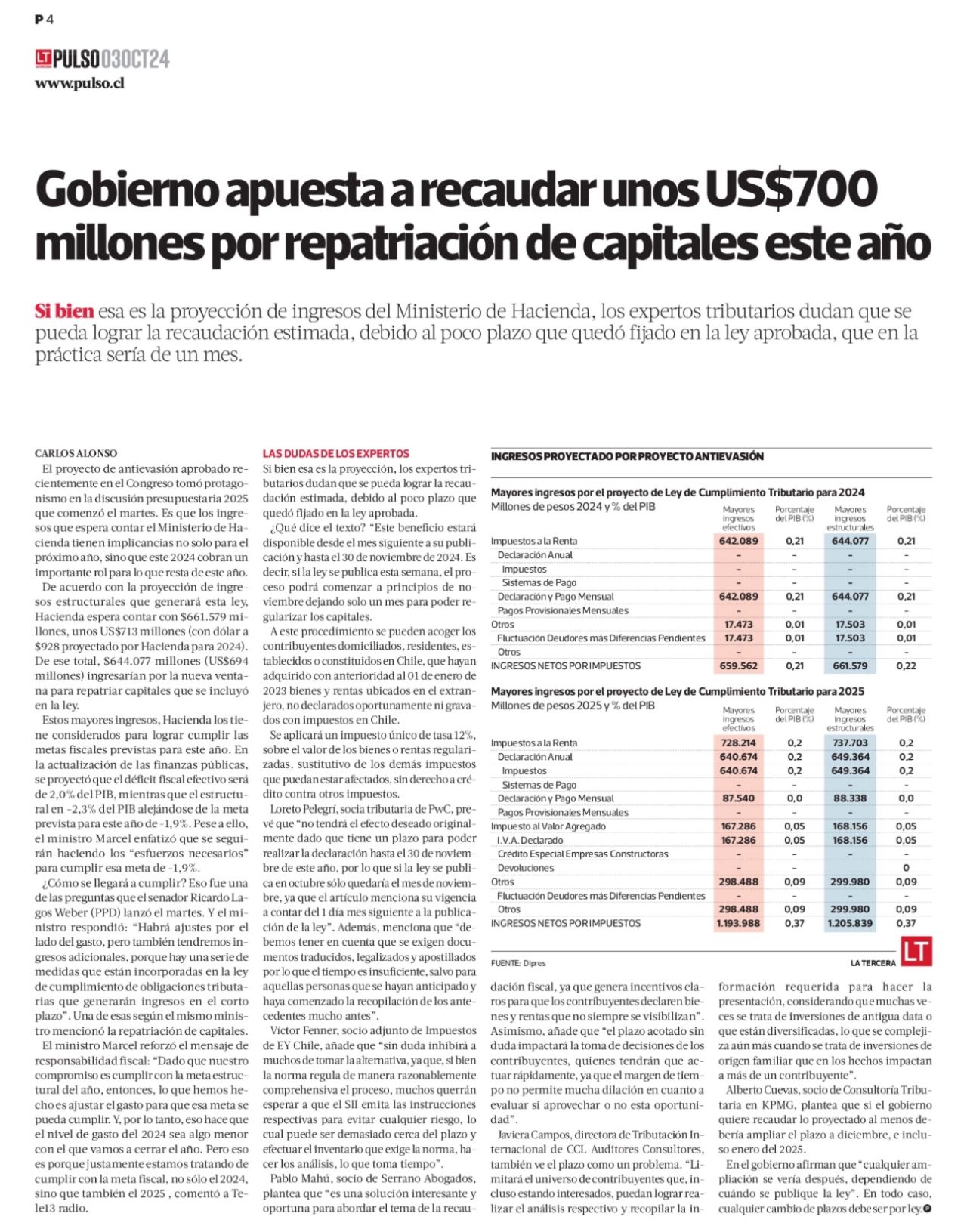
Although this is the projected revenue, tax experts doubt that the estimated collection can be achieved due to the short timeframe established in the approved law, which in practice would be only one month.
Read the article in La Tercera-Pulso.
The recently approved anti-evasion bill has taken center stage in the 2025 budget discussion that began on Tuesday. The revenue expected by the Ministry of Finance has implications not only for next year but also plays an important role for the remainder of 2024.
According to the structural revenue projections generated by this law, the Treasury expects to receive $661,579 million, approximately US$713 million (based on an exchange rate of $928 projected by the Treasury for 2024). Of that total, $644,077 million (US$694 million) would come from the new capital repatriation window included in the law.
These additional revenues are considered by the Treasury to meet the fiscal targets set for this year. In the public finance update, the effective fiscal deficit was projected at 2.0% of GDP, while the structural deficit would reach -2.3% of GDP, moving away from this year’s target of -1.9%. Despite this, Minister Marcel emphasized that “the necessary efforts” will continue to be made to meet that -1.9% target.
How will this be achieved? That was one of the questions raised by Senator Ricardo Lagos Weber (PPD) on Tuesday. The minister responded: “There will be adjustments on the spending side, but we will also have additional revenues, as there are a number of measures included in the Tax Compliance Law that will generate short-term income.” One of these, as mentioned by the minister, is capital repatriation.
Minister Marcel reinforced the message of fiscal responsibility: “Given that our commitment is to meet the structural target for the year, what we have done is adjust spending so that this target can be achieved. Therefore, the level of spending in 2024 will be somewhat lower than what we will close the year with. But this is precisely because we are trying to meet the fiscal target, not only for 2024 but also for 2025,” he commented on Tele13 Radio.
Experts’ concerns
Although this is the projection, tax experts doubt that the estimated revenue can be achieved due to the limited timeframe established in the approved law.
What does the text say? “This benefit will be available from the month following its publication until November 30, 2024.” In other words, if the law is published this week, the process could begin in early November, leaving only one month to regularize capital.
This procedure is available to taxpayers domiciled, resident, established, or incorporated in Chile who, prior to January 1, 2023, acquired assets and income located abroad that were not declared in a timely manner nor taxed in Chile.
A single tax rate of 12% will be applied to the value of the regularized assets or income, substituting any other applicable taxes, without the right to credits against other taxes.
Loreto Pelegrí, tax partner at PwC, anticipates that “it will not have the originally intended effect, given that the deadline to submit the declaration is November 30 of this year. If the law is published in October, only the month of November would remain, since the article states its validity begins on the first day of the month following publication.” She also notes that “we must consider that documents must be translated, legalized, and apostilled, so the time is insufficient, except for those who anticipated this and began gathering documentation well in advance.”
Víctor Fenner, associate tax partner at EY Chile, adds that “it will undoubtedly discourage many from opting for the alternative, as although the rule regulates the process reasonably comprehensively, many will prefer to wait for the SII to issue the relevant instructions to avoid any risk, which could occur too close to the deadline. Additionally, compiling the required inventory and conducting the necessary analyses takes time.”
Pablo Mahú, partner at Serrano Abogados, states that “it is an interesting and timely solution to address fiscal revenue, as it creates clear incentives for taxpayers to declare assets and income that are not always visible.” He also adds that “the limited timeframe will undoubtedly impact taxpayer decision-making, as they will have to act quickly, given that there is little room for delay in evaluating whether to take advantage of this opportunity.”
Javiera Campos, Director of International Taxation at CCL Auditores Consultores, also views the timeframe as a problem: “It will limit the number of taxpayers who, even if interested, are able to conduct the necessary analysis and gather the required information to submit the declaration, especially considering that these are often long-standing or diversified investments, which become even more complex when they involve family-origin investments affecting multiple taxpayers.”
Likewise, Alberto Cuevas, partner in Tax Consulting at KPMG, states that if the government aims to achieve the projected revenue, it should at least extend the deadline to December, or even January 2025.
Government officials state that “any extension will be evaluated later, depending on when the law is published.” In any case, any change to deadlines must be made through legislation.