
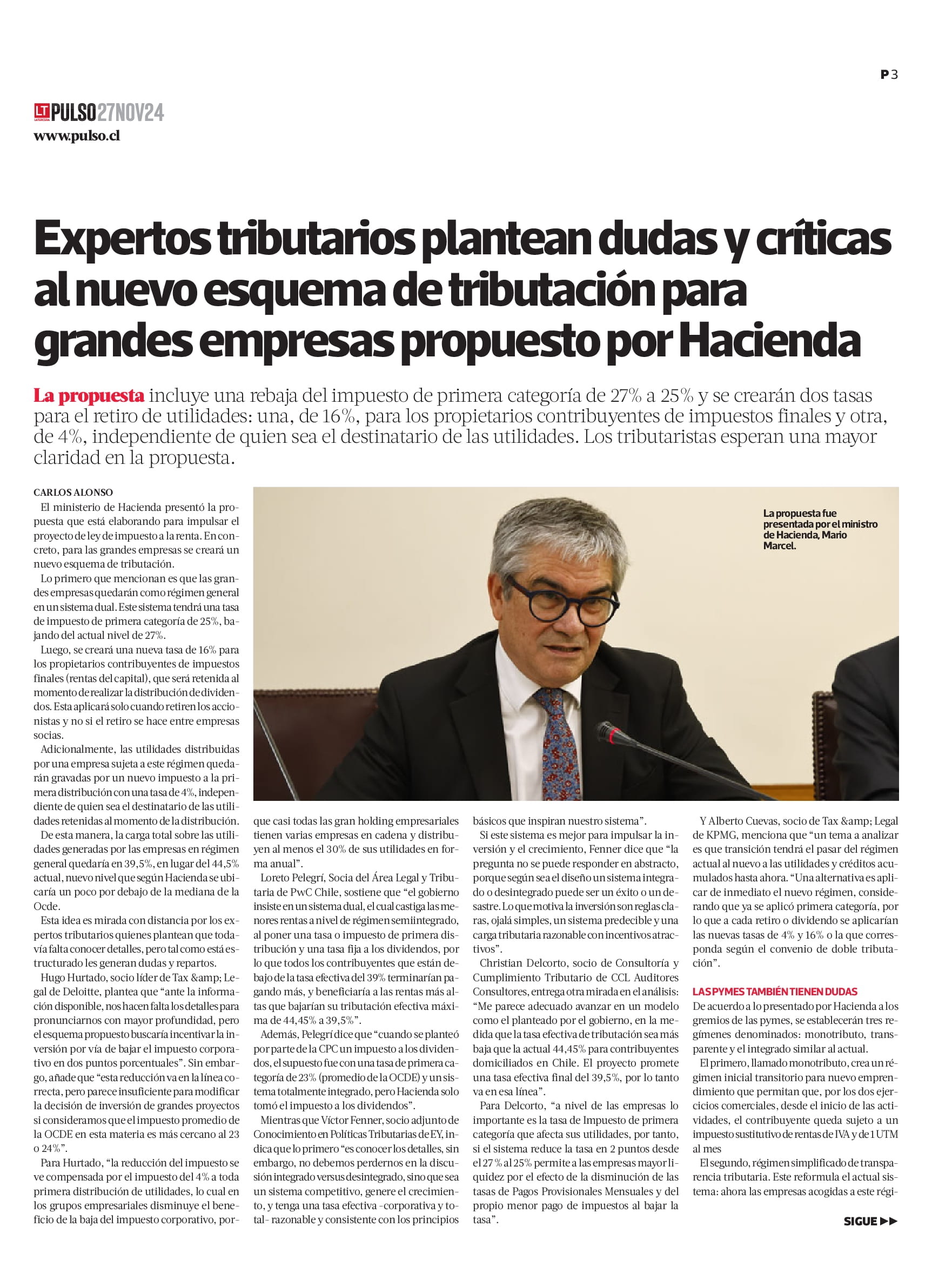
The proposal includes a reduction of the corporate tax rate from 27% to 25%, and the creation of two rates for profit withdrawals: one at 16% for owners subject to final taxes, and another at 4%, regardless of who receives the profits. Tax experts expect greater clarity in the proposal.
Read the article in La Tercera-Pulso.
The Ministry of Finance presented the proposal it is developing to advance the income tax bill. Specifically, a new taxation scheme will be created for large companies.
First, large companies will fall under a dual system as the general regime. This system will have a corporate tax rate of 25%, reduced from the current 27%.
Then, a new 16% rate will be created for owners subject to final taxes (capital income), which will be withheld at the time dividends are distributed. This will apply only when shareholders withdraw profits, not when distributions occur between partner companies.
Additionally, profits distributed by a company under this regime will be subject to a new tax on the first distribution at a rate of 4%, regardless of who receives the retained earnings at the time of distribution.
As a result, the total tax burden on corporate profits under the general regime would decrease to 39.5%, compared to the current 44.5%, a level that, according to the Ministry of Finance, would be slightly below the OECD median.
This proposal is viewed with caution by tax experts, who note that more details are still needed, but as currently structured, it raises doubts and concerns.
Hugo Hurtado, Lead Partner of Tax & Legal at Deloitte, stated that “based on the available information, we still lack sufficient details to provide a deeper assessment, but the proposed scheme appears to aim at encouraging investment by reducing the corporate tax rate by two percentage points.” However, he added that “this reduction is in the right direction, but it seems insufficient to significantly influence large-scale investment decisions, considering that the OECD average is closer to 23% or 24%.”
For Hurtado, “the reduction in corporate tax is offset by the 4% tax on the first distribution of profits, which, in business groups, reduces the benefit of lowering the corporate tax rate, since most large corporate holdings consist of multiple companies in a chain that distribute at least 30% of their profits annually.”
Loreto Pelegrí, Partner in the Legal and Tax Area at PwC Chile, argues that “the government continues to push for a dual system, which penalizes lower incomes under the semi-integrated regime by imposing a tax on first distribution and a fixed rate on dividends. As a result, taxpayers below the effective rate of 39% would end up paying more, while higher-income taxpayers would benefit from a reduction in their effective tax rate from 44.45% to 39.5%.”
Additionally, Pelegrí noted that “when the CPC proposed a dividend tax, it was under the assumption of a 23% corporate tax rate (OECD average) and a fully integrated system, but the Ministry of Finance only adopted the dividend tax component.”
Víctor Fenner, Associate Partner of Tax Policy Knowledge at EY, stated that “the first step is to understand the details, but we should not get lost in the integrated versus disintegrated debate. Instead, the focus should be on ensuring a competitive system that promotes growth, with a reasonable and consistent effective tax rate aligned with the fundamental principles of our system.”
Regarding whether this system is better for promoting investment and growth, Fenner noted that “the question cannot be answered in the abstract, as depending on the design, both integrated and disintegrated systems can either succeed or fail. What truly drives investment is clear, preferably simple rules, a predictable system, and a reasonable tax burden with attractive incentives.”
Christian Delcorto, Partner of Tax Consulting and Compliance at CCL Auditores Consultores, offers another perspective: “It seems appropriate to move toward a model like the one proposed by the government, provided that the effective tax rate is lower than the current 44.45% for taxpayers domiciled in Chile. The project promises a final effective rate of 39.5%, which moves in that direction.”
For Delcorto, “at the corporate level, what matters most is the first-category tax rate affecting profits. Therefore, reducing the rate by two percentage points—from 27% to 25%—provides companies with greater liquidity through lower provisional monthly payments and reduced tax obligations.”
Alberto Cuevas, Tax & Legal partner at KPMG, pointed out that “one issue to analyze is the transition from the current system to the new one, particularly regarding accumulated profits and tax credits. One option would be to immediately apply the new system, considering that the corporate tax has already been paid, so each withdrawal or dividend would be subject to the new 4% and 16% rates or those established under applicable tax treaties.”
According to the proposal presented by the Ministry of Finance to SME associations, three regimes will be established: a monotribute system, a transparent regime, and an integrated system similar to the current one.
The first, known as the monotribute system, introduces a transitional regime for new businesses, under which, for the first two fiscal years, taxpayers will be subject to a substitute tax covering VAT and income, equivalent to 1 monthly tax unit.
The second is a simplified transparent tax regime. This reformulates the current system: companies under this regime will be exempt from paying corporate tax, and the owner will be taxed according to their personal income bracket under the Global Complementary Tax.
As a general rule, the company must allocate its net income to its owners, regardless of whether it has been distributed. This includes profits derived from dividends received from third parties.
The third regime would maintain the current integrated system as an alternative. It is worth noting that this year the corporate tax rate is 12.5%, and if no legal changes occur, it will rise to 25% next year. However, since large companies under the general regime would pay 25%, the SME rate is expected to be adjusted to a level still under evaluation.
Eduardo del Solar, Executive Director of the Health Industry Suppliers Association, stated that although this is a preliminary proposal, discussions must continue, as the transparent regime is not entirely satisfactory for them.
Roberto Rojas, representative of Conupia, noted that the corporate tax rate still needs to be determined, and while progress has been made, there is not yet broad agreement between SMEs and the government.
Juan Pablo Swett, President of the National Multiguild Association, stated that “for them, the transparent regime cannot become the general regime, as it resembles the attributed income system. For us, the general system should be the integrated one, with a uniform 10% rate for all SMEs.”
Jorge Welch, President of the Chilean Entrepreneurs Association (Asech), added that “the transparent system seems like a good starting point, although it still needs clarification in some areas. Regarding the gradual increase in rates, no amounts, timelines, or feasibility were discussed. It was only addressed from the premise that the tax structure should incentivize SMEs and entrepreneurs to grow rather than remain small.”
Next Friday, the Confederation of Production and Commerce (CPC) and the Society for Industrial Development (Sofofa) will attend a working meeting with the Ministry of Finance. Topics to be discussed include permitting processes, environmental evaluation reform, and the income tax reform. This will be the first meeting in a new round of discussions between the government and the private sector.
Regarding the proposal to reform the corporate tax system, Sofofa President Rosario Navarro stated that “although a reduction in the corporate tax rate proposed by the Ministry of Finance is a step in the right direction, the proposal is not proportional to the scale of change our economy requires. Furthermore, it continues to promote a dual system, which does not help simplify our already complex tax system.”