
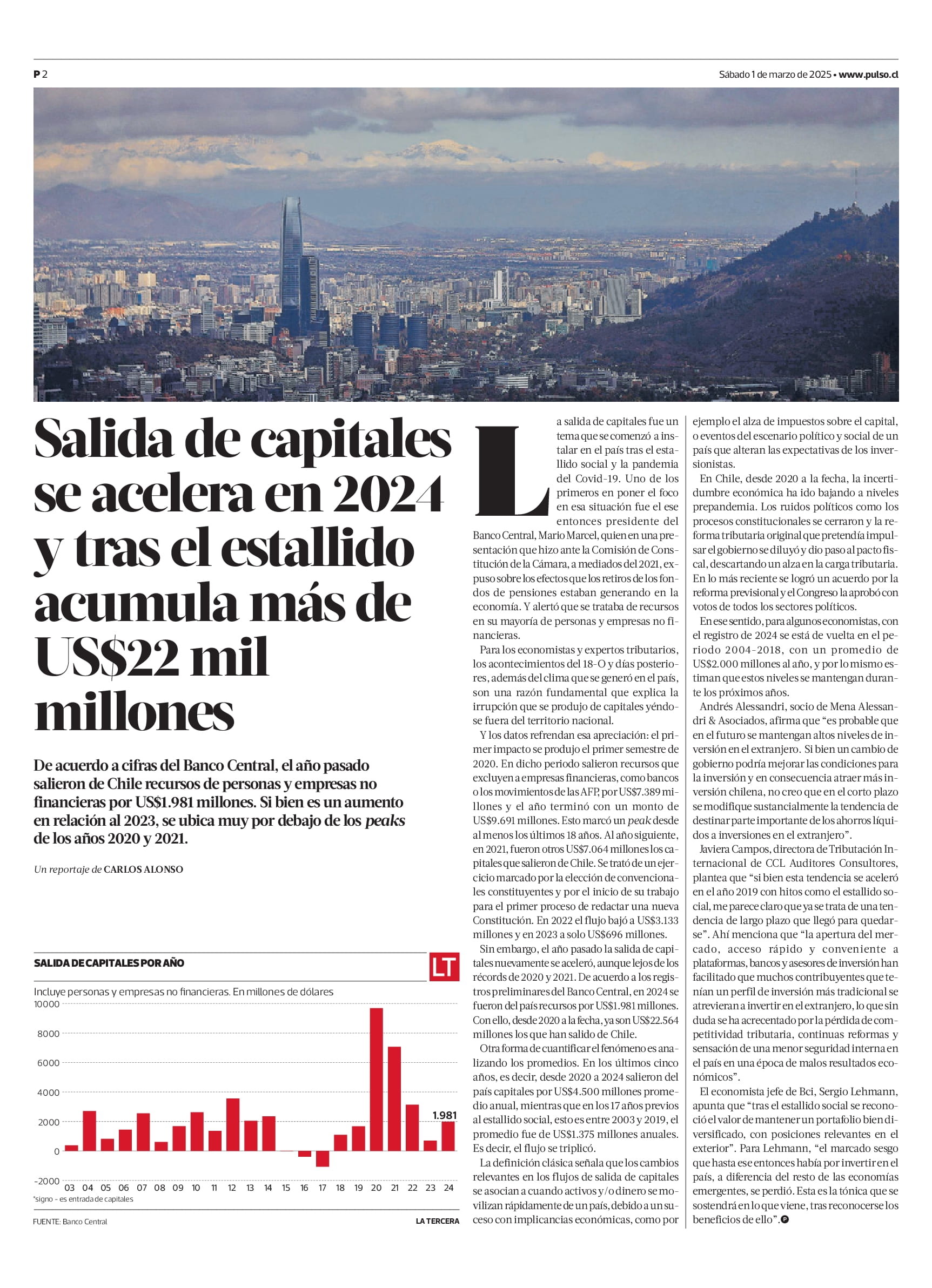
According to data from the Central Bank, last year US$1.981 billion left Chile from individuals and non-financial companies. While this represents an increase compared to 2023, it remains well below the peaks seen in 2020 and 2021.
Read the article in La Tercera-Pulso.
Capital outflows became a prominent issue in Chile following the social unrest and the Covid-19 pandemic. One of the first to highlight this situation was the then-President of the Central Bank, Mario Marcel, who in a presentation before the Chamber’s Constitution Committee in mid-2021 discussed the effects that pension fund withdrawals were having on the economy. He warned that these were primarily resources from individuals and non-financial companies.
For economists and tax experts, the events of October 18 and the days that followed, along with the climate that emerged in the country, are a key reason behind the surge of capital leaving the national territory.
The data supports this view: the first impact occurred in the first half of 2020. During that period, capital outflows—excluding financial institutions such as banks and pension fund movements—amounted to US$7.389 billion, and the year ended with a total of US$9.691 billion. This marked a peak over at least the past 18 years. The following year, 2021, saw an additional US$7.064 billion leave Chile. This period was marked by the election of constitutional convention members and the beginning of the constitutional drafting process. In 2022, the outflow dropped to US$3.133 billion, and in 2023 to just US$696 million.
However, last year capital outflows accelerated again, although still far from the record levels of 2020 and 2021. According to preliminary Central Bank data, US$1.981 billion left the country in 2024. This brings total outflows since 2020 to US$22.564 billion.
Another way to measure the phenomenon is through averages. Over the past five years (2020–2024), average annual capital outflows reached US$4.5 billion, whereas in the 17 years prior to the social unrest (2003–2019), the average was US$1.375 billion annually. In other words, the flow has tripled.
The traditional definition suggests that significant changes in capital outflows occur when assets and/or money move rapidly out of a country due to events with economic implications, such as increases in capital taxation or political and social developments that alter investor expectations.
In Chile, since 2020, economic uncertainty has gradually declined to pre-pandemic levels. Political uncertainties, such as constitutional processes, have concluded, and the original tax reform proposed by the government was replaced by a fiscal pact, ruling out an increase in the tax burden. More recently, a pension reform agreement was reached and approved by Congress with support from across the political spectrum.
In this context, some economists believe that with the 2024 figures, Chile has returned to levels similar to the 2004–2018 period, with an average of around US$2 billion per year, and they expect these levels to remain stable in the coming years.
Andrés Alessandri, partner at Mena Alessandri & Asociados, states that “it is likely that high levels of investment abroad will persist in the future. Although a change in government could improve conditions for investment and attract more domestic capital, I do not believe that in the short term the trend of allocating a significant portion of liquid savings to foreign investments will change substantially.”
Javiera Campos, Director of International Taxation at CCL Auditores Consultores, notes that “while this trend accelerated in 2019 with events such as the social unrest, it is now clearly a long-term trend that is here to stay.” She adds that “market openness, as well as quick and convenient access to platforms, banks, and investment advisors, has enabled many taxpayers with traditionally conservative investment profiles to invest abroad. This has undoubtedly been reinforced by declining tax competitiveness, ongoing reforms, and a perception of reduced domestic security amid weak economic performance.”
Bci’s chief economist, Sergio Lehmann, points out that “after the social unrest, the value of maintaining a well-diversified portfolio with significant exposure abroad became evident.” According to Lehmann, “the strong bias toward domestic investment that previously existed—unlike in other emerging economies—has disappeared. This trend will likely continue, given the recognized benefits of diversification.”