
According to experts, a smaller gap would make it more difficult to achieve the 1.5% of GDP revenue target estimated by the government to finance, among other initiatives, the increase in the Universal Guaranteed Pension (PGU).
Read the article in El Mercurio.
One of the technical inputs used during the discussion of the tax compliance law was the controversial study by the Internal Revenue Service (SII) estimating the tax compliance gap for VAT and First Category tax. That report estimated average evasion of 18.4% for VAT and 51.4% for corporate tax during the 2018–2020 period.
The methodology never fully convinced experts. As a result, SII Director Javier Etcheberry updated the calculations with several adjustments in an effort to address those concerns.
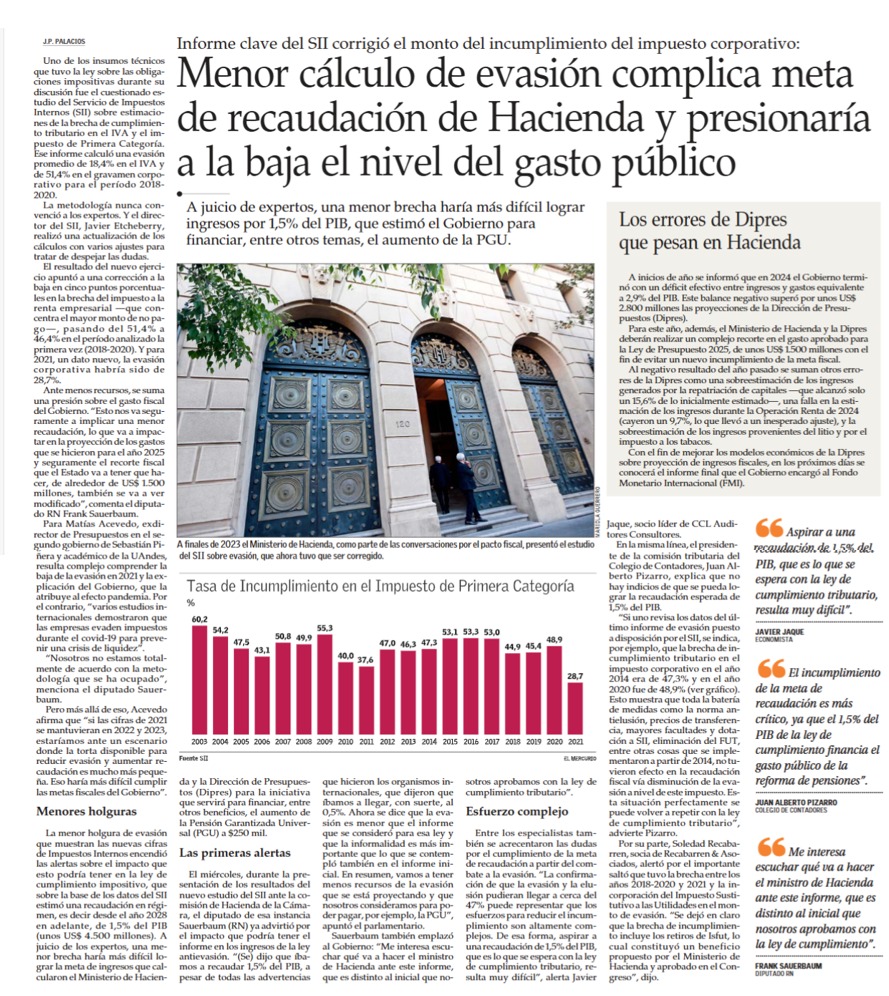
The updated results pointed to a five-percentage-point reduction in the corporate income tax gap—which represents the largest share of unpaid taxes—falling from 51.4% to 46.4% for the originally analyzed period (2018–2020). For 2021, a new data point, corporate tax evasion was estimated at 28.7%.
With fewer available resources, additional pressure is placed on government spending. “This will likely result in lower revenue, impacting expenditure projections for 2025 and potentially altering the fiscal adjustment the State will need to make, estimated at around US$1.5 billion,” commented RN congressman Frank Sauerbaum.
For Matías Acevedo, former Budget Director during Sebastián Piñera’s second administration and academic at Universidad de los Andes, the reduction in evasion for 2021 is difficult to explain, particularly as the government attributes it to the pandemic. On the contrary, “several international studies have shown that companies tend to evade taxes during crises such as COVID-19 to preserve liquidity.”
“We do not fully agree with the methodology used,” added congressman Sauerbaum.
Beyond that, Acevedo argues that “if the 2021 figures persist into 2022 and 2023, we would face a scenario where the available base for reducing evasion and increasing revenue is much smaller. This would make it more difficult to meet the government’s fiscal targets.”
Reduced Fiscal Space
The lower evasion gap shown in the updated SII figures has raised concerns about its impact on the tax compliance law, which—based on the original estimates—projected steady-state revenue of 1.5% of GDP (approximately US$4.5 billion) starting in 2028. According to experts, a smaller gap makes it more difficult to achieve this revenue target, which is intended to finance, among other measures, the increase of the Universal Guaranteed Pension (PGU) to CLP 250,000.
Early Warnings
On Wednesday, during the presentation of the updated SII study before the Finance Committee of the Chamber of Deputies, congressman Sauerbaum (RN) warned of the potential impact on expected revenues from anti-evasion measures. “It was said that we would collect 1.5% of GDP, despite warnings from international organizations suggesting it would barely reach 0.5%. Now we are told that evasion is lower than initially estimated and that informality is more significant. In summary, we will have fewer resources than projected to finance measures such as the PGU,” he stated.
Sauerbaum also called on the government: “I am interested in hearing what the Minister of Finance will do in response to this report, which differs from the one originally used to approve the tax compliance law.”
Complex Effort
Among specialists, concerns have also increased regarding the feasibility of achieving the expected revenue through anti-evasion efforts. “The confirmation that evasion and avoidance could reach around 47% suggests that efforts to reduce non-compliance are highly complex. Therefore, aiming for revenue of 1.5% of GDP, as projected under the tax compliance law, appears very difficult,” warned Javier Jaque, Managing Partner of CCL Auditores Consultores.
Similarly, Juan Alberto Pizarro, president of the Tax Commission of the Association of Accountants, noted that there is no clear evidence that the expected 1.5% of GDP in revenue can be achieved.
“If we review the latest SII report on evasion, it shows that the corporate tax compliance gap was 47.3% in 2014 and 48.9% in 2020 (see chart). This indicates that all the measures implemented since 2014—such as anti-avoidance rules, transfer pricing regulations, expanded SII powers, elimination of the FUT system, among others—have not effectively increased tax revenue through reduced evasion. This situation could very well repeat itself under the tax compliance law,” warned Pizarro.
For her part, Soledad Recabarren, partner at Recabarren & Asociados, highlighted the significant change in the compliance gap between 2018–2020 and 2021, as well as the inclusion of the Substitute Tax on Profits (ISFUT) in the evasion figures. “It was clarified that the compliance gap includes ISFUT withdrawals, which was a benefit proposed by the Ministry of Finance and approved by Congress,” she explained.
Dipres Errors Weighing on the Ministry of Finance
At the beginning of the year, it was reported that in 2024 the government ended with an effective deficit between revenues and expenditures equivalent to 2.9% of GDP. This negative balance exceeded projections by the Budget Office (Dipres) by approximately US$2.8 billion.
For this year, the Ministry of Finance and Dipres must implement a complex spending cut of approximately US$1.5 billion to comply with fiscal targets and avoid further deviations.
In addition to last year’s negative results, Dipres made other forecasting errors, including an overestimation of revenues from capital repatriation—which reached only 15.6% of the initial estimate—a miscalculation of revenues during the 2024 tax filing process (which fell by 9.7%), and overestimated revenues from lithium and tobacco taxes.
To improve fiscal revenue forecasting models, the government has commissioned a final report from the International Monetary Fund (IMF), which is expected to be released in the coming days.
“Aiming for revenue of 1.5% of GDP, as projected under the tax compliance law, is very difficult.”
Javier Jaque, Economist.
“Failure to meet the revenue target is even more critical, as the 1.5% of GDP expected from the tax compliance law finances public spending related to pension reform.”
Juan Alberto Pizarro, Association of Accountants.
“I am interested in hearing what the Minister of Finance will do in response to this report, which differs from the one originally used to approve the compliance law.”
Frank Sauerbaum, RN Congressman.