
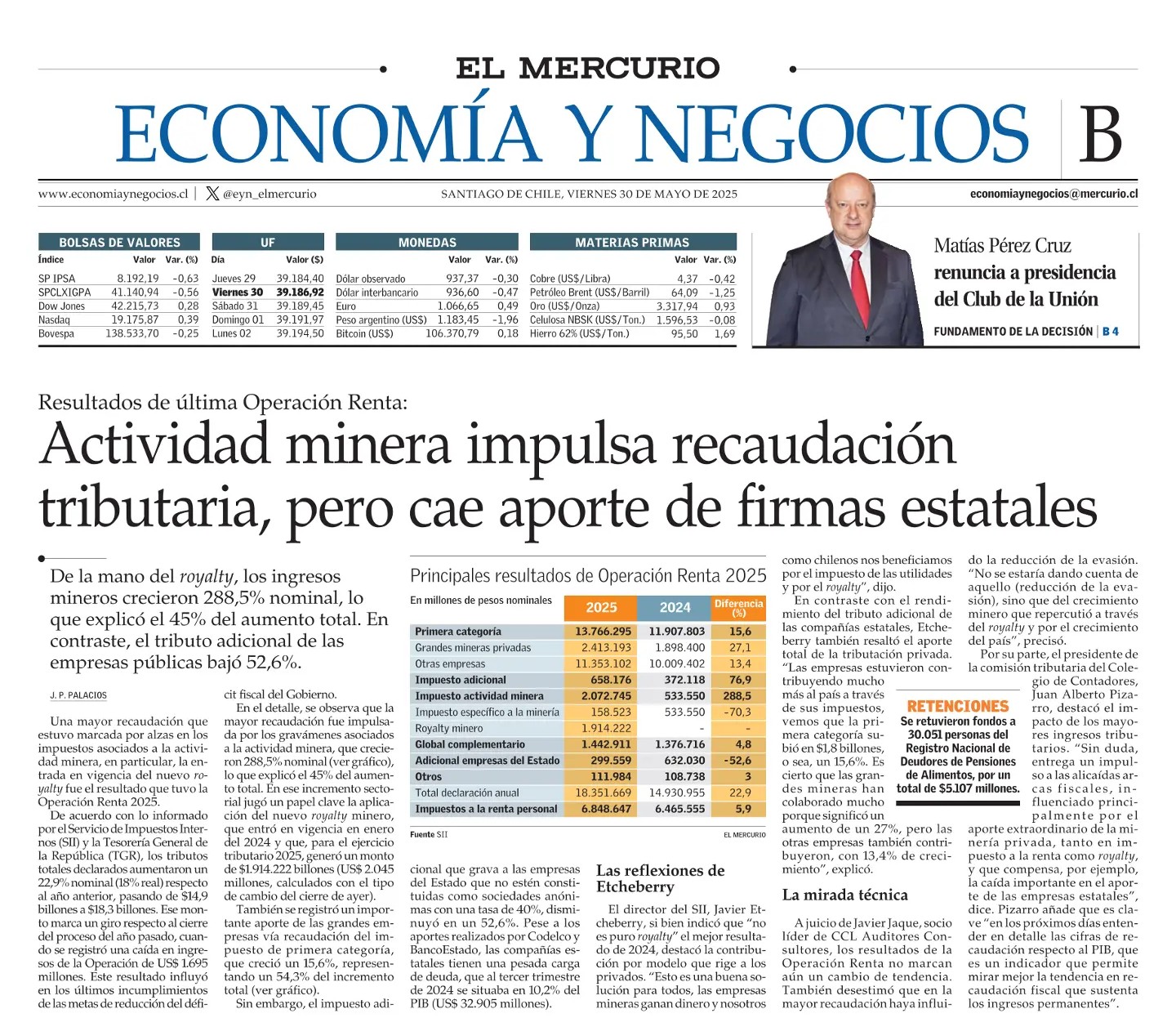
Driven by the royalty, mining revenues grew 288.5% in nominal terms, accounting for 45% of the total increase. In contrast, the additional tax from state-owned companies fell by 52.6%.
Withholdings
Funds were withheld from 30,051 individuals listed in the National Registry of Child Support Debtors, totaling CLP 5.107 billion.
Higher tax collection, marked by increases in taxes associated with mining activity—particularly the implementation of the new royalty—was the outcome of the 2025 tax filing process (Operación Renta).
According to information from the Internal Revenue Service (SII) and the General Treasury of the Republic (TGR), total declared taxes increased by 22.9% in nominal terms (18% in real terms) compared to the previous year, rising from CLP 14.9 trillion to CLP 18.3 trillion. This represents a reversal compared to the previous year’s process, which recorded a revenue decline of US$1.695 billion. This result also influenced recent shortfalls in the government’s fiscal deficit reduction targets.
In detail, the increase in tax collection was driven by levies associated with mining activity, which grew by 288.5% in nominal terms (see chart), accounting for 45% of the total increase. A key factor in this sectoral growth was the implementation of the new mining royalty, which came into effect in January 2024 and, for the 2025 tax year, generated CLP 1.914 trillion (approximately US$2.045 billion, based on the exchange rate at the close of the previous day).
There was also a significant contribution from large companies through First Category tax collection, which grew by 15.6%, representing 54.3% of the total increase (see chart).
However, the additional tax applied to state-owned enterprises not structured as corporations—taxed at a 40% rate—decreased by 52.6%. Despite contributions from Codelco and BancoEstado, state-owned companies carry a heavy debt burden, which stood at 10.2% of GDP (US$32.905 billion) as of the third quarter of 2024.
Etcheberry’s reflections
The Director of the SII, Javier Etcheberry, while noting that the improved 2024 result is “not just due to the royalty,” highlighted the contribution from the model governing private companies. “This is a good solution for everyone—mining companies make profits, and we as Chileans benefit through profit taxes and the royalty,” he stated.
In contrast to the performance of taxes from state-owned companies, Etcheberry also emphasized the overall contribution of private-sector taxation. “Companies have been contributing much more to the country through their taxes. We see that First Category tax increased by CLP 1.8 trillion, or 15.6%. It is true that large mining companies contributed significantly, with a 27% increase, but other companies also contributed, with 13.4% growth,” he explained.
Technical perspective
According to Javier Jaque, Managing Partner of CCL Auditores Consultores, the results of the tax filing process do not yet indicate a change in trend. He also dismissed the idea that increased revenue was driven by reduced tax evasion. “What we are seeing is not a reflection of reduced evasion, but rather mining growth, which has had an impact through the royalty and overall economic growth,” he stated.
Meanwhile, Juan Alberto Pizarro, president of the Tax Commission of the Association of Accountants, highlighted the impact of higher tax revenues. “It undoubtedly provides a boost to strained public finances, mainly driven by the extraordinary contribution from private mining, both through income tax and royalty, which offsets, for example, the significant decline in contributions from state-owned companies,” he said. Pizarro added that it will be key “in the coming days to understand in detail the relationship between tax revenue and GDP, as this indicator provides a clearer view of trends in fiscal revenue that support permanent income.”