
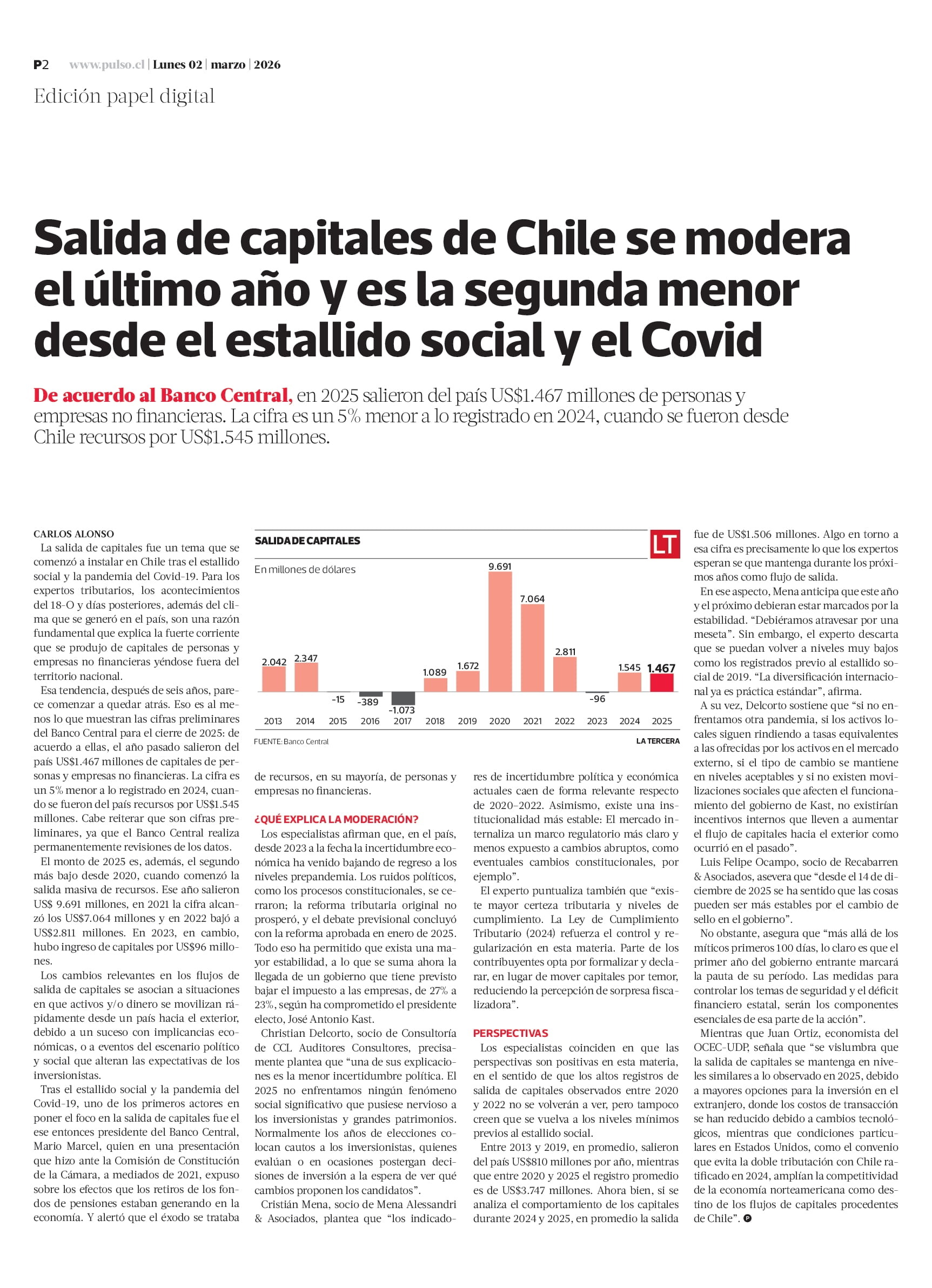
According to the Central Bank, in 2025 US$1.467 billion left the country from individuals and non-financial companies. This figure is 5% lower than what was recorded in 2024, when US$1.545 billion in resources left Chile.
Read the article at La Tercera-Pulso.
Capital outflows became a prominent issue in Chile following the social unrest and the Covid-19 pandemic. For tax experts, the events of October 18 and the days that followed, along with the climate that emerged in the country, are a key reason explaining the strong flow of capital from individuals and non-financial companies leaving the national territory.
That trend, after six years, now appears to be starting to fade. This is at least what preliminary figures from the Central Bank for the end of 2025 show: according to these, last year US$1.467 billion in capital left the country from individuals and non-financial companies. The figure is 5% lower than what was recorded in 2024, when US$1.545 billion left the country. It should be noted that these are preliminary figures, as the Central Bank continuously revises its data.
The 2025 amount is also the second lowest since 2020, when the massive outflow of resources began. That year, US$9.691 billion left, in 2021 the figure reached US$7.064 billion, and in 2022 it dropped to US$2.811 billion. In contrast, in 2023 there was a capital inflow of US$96 million.
Significant changes in capital outflow flows are associated with situations in which assets and/or money move rapidly from a country to abroad, due to events with economic implications, or political and social developments that alter investor expectations.
Following the social unrest and the Covid-19 pandemic, one of the first figures to highlight capital outflows was then Central Bank President Mario Marcel, who, in a presentation to the Constitution Committee of the Chamber in mid-2021, outlined the effects that pension fund withdrawals were having on the economy. He warned that the outflow consisted mainly of resources from individuals and non-financial companies.
What explains the moderation?
Specialists state that in the country, since 2023, economic uncertainty has been declining back to pre-pandemic levels. Political noise, such as constitutional processes, has subsided; the original tax reform did not move forward; and the pension debate concluded with the reform approved in January 2025. All of this has contributed to greater stability, in addition to the arrival of a government that plans to reduce corporate taxes from 27% to 23%, as committed by President-elect José Antonio Kast.
Christian Delcorto, Consulting Partner at CCL Auditores Consultores, notes that “one explanation is the lower political uncertainty. In 2025, we did not face any significant social events that would have unsettled investors and large fortunes. Election years typically make investors cautious, as they evaluate or sometimes postpone investment decisions while waiting to see what changes candidates propose.”
Cristián Mena, partner at Mena Alessandri & Asociados, states that “current political and economic uncertainty indicators have declined significantly compared to 2020–2022. Additionally, there is a more stable institutional framework: the market internalizes a clearer regulatory framework that is less exposed to abrupt changes, such as potential constitutional changes, for example.”
The expert also points out that “there is greater tax certainty and compliance levels. The Tax Compliance Law (2024) strengthens control and regularization in this area. Some taxpayers choose to formalize and declare, rather than move capital out of fear, reducing the perception of unexpected enforcement.”
Outlook
Specialists agree that the outlook is positive in this regard, meaning that the high levels of capital outflows observed between 2020 and 2022 are unlikely to return, although they also do not expect a return to the very low levels seen prior to the 2019 social unrest.
Between 2013 and 2019, an average of US$810 million left the country annually, while between 2020 and 2025 the average reached US$3.747 billion. However, if the behavior during 2024 and 2025 is analyzed, the average outflow was US$1.506 billion. This is roughly the level that experts expect to persist in the coming years.
In this regard, Mena anticipates that this year and next should be marked by stability. “We should go through a plateau.” However, he rules out a return to very low levels like those seen before the 2019 social unrest. “International diversification is now standard practice,” he states.
Meanwhile, Delcorto argues that “if we do not face another pandemic, if local assets continue to yield returns comparable to those offered by assets in external markets, if the exchange rate remains at acceptable levels, and if there are no social movements affecting the functioning of the Kast government, there would be no internal incentives to increase capital outflows as occurred in the past.”
Luis Felipe Ocampo, partner at Recabarren & Asociados, states that “since December 14, 2025, there has been a sense that things may become more stable due to the change in direction of the government.”
However, he notes that “beyond the symbolic first 100 days, what is clear is that the first year of the incoming government will set the tone for its term. Measures to control security issues and the state’s financial deficit will be essential components of that phase.”
Meanwhile, Juan Ortiz, economist at OCEC-UDP, states that “it is expected that capital outflows will remain at levels similar to those observed in 2025, due to increased opportunities for investment abroad, where transaction costs have decreased due to technological changes. Additionally, specific conditions in the United States, such as the double taxation agreement with Chile ratified in 2024, enhance the competitiveness of the U.S. economy as a destination for capital flows from Chile.”