
The Executive branch is seeking to anticipate the limits that the Council will aim to set during the legislative debate, incorporating measures such as combating cigarette smuggling and improving the collection management of CAE (state-guaranteed student loans).
For many stakeholders, the message delivered by the President of the Autonomous Fiscal Council (CFA), Paula Benavides, regarding the impact on public finances of the “national reconstruction” plan to be announced today by the government did not go unnoticed.
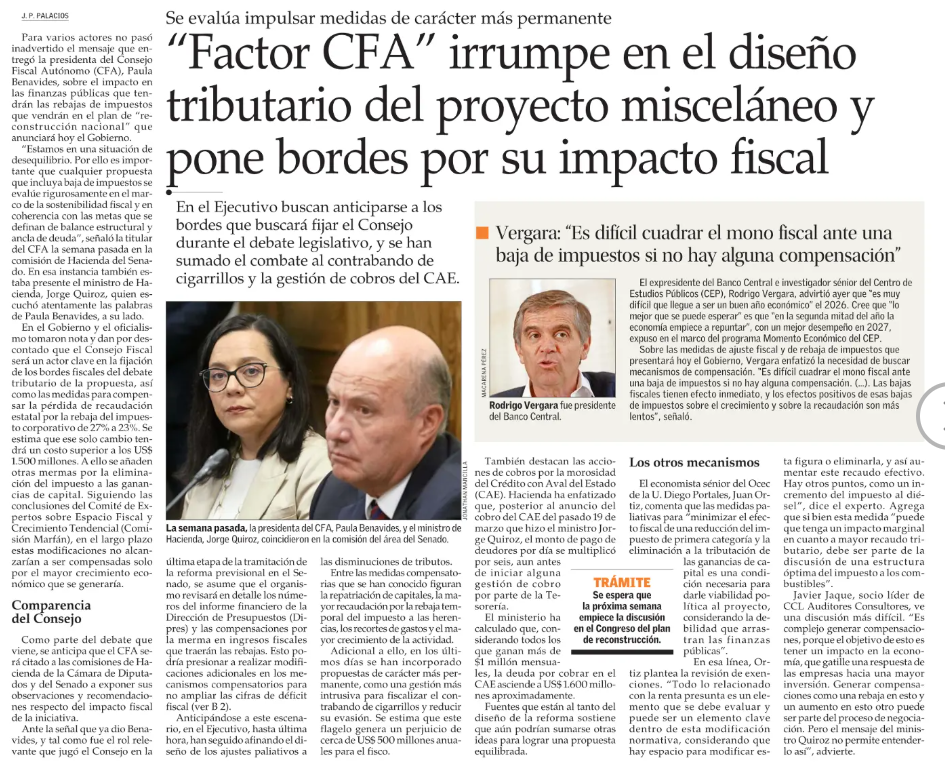
“We are in a situation of imbalance. Therefore, it is important that any proposal involving tax cuts be rigorously evaluated within the framework of fiscal sustainability and in line with the structural balance and debt anchor targets,” the head of the CFA stated last week before the Senate Finance Committee. The Minister of Finance, Jorge Quiroz, was also present at the session, listening attentively to Benavides’ remarks.
Within the government and the ruling coalition, this message has been duly noted, and it is taken for granted that the Fiscal Council will be a key player in setting the fiscal boundaries of the tax debate, as well as in assessing the measures to compensate for the loss in government revenue resulting from the reduction of the corporate tax rate from 27% to 23%. This change alone is estimated to cost over USD 1.5 billion. Additional losses would stem from the elimination of the capital gains tax. According to the conclusions of the Committee of Experts on Fiscal Space and Trend Growth (Marfán Commission), in the long term these changes would not be fully offset by higher economic growth alone.
Council’s appearance
As part of the upcoming debate, it is expected that the CFA will be summoned to the Finance Committees of both the Chamber of Deputies and the Senate to present its observations and recommendations regarding the fiscal impact of the initiative.
Given the signal already delivered by Benavides—and similar to the key role the Council played during the final stage of the pension reform debate in the Senate—it is assumed that the body will thoroughly review the figures in the financial report prepared by the Budget Office (Dipres), as well as the compensatory measures for the decline in fiscal revenues resulting from the tax cuts. This could lead to pressure for additional adjustments to compensation mechanisms in order to avoid widening the fiscal deficit.
In anticipation of this scenario, the Executive has continued refining the design of the tax reform included in the omnibus bill up until the last minute.
Among the compensatory measures that have been discussed are capital repatriation, increased revenue from a temporary reduction in inheritance taxes, spending cuts, and higher economic activity.
Additionally, in recent days more permanent proposals have been incorporated, such as a more intensive approach to monitoring cigarette smuggling and reducing tax evasion. This issue is estimated to cause losses of around USD 500 million annually for the Treasury.
The Executive is also focusing on strengthening the collection of overdue CAE (state-guaranteed student loan) payments. The Ministry of Finance has emphasized that, following the announcement made on March 19 by Minister Jorge Quiroz, daily payments from debtors increased sixfold, even before any formal collection actions by the Treasury had begun.
The Ministry estimates that, considering all individuals earning more than CLP 1 million per month, outstanding CAE debt amounts to approximately USD 1.6 billion.
Sources familiar with the reform design indicate that additional ideas could still be incorporated to achieve a balanced proposal.
Vergara: “It is difficult to balance the fiscal accounts with tax cuts if there is no compensation”
Former Central Bank President and senior researcher at the Center for Public Studies (CEP), Rodrigo Vergara, warned that “it is very difficult for 2026 to be a strong economic year. The best we can expect is that ‘in the second half of the year the economy begins to recover,’ with improved performance under the CEP’s Economic Momentum program.”
Regarding the fiscal adjustment and tax cut measures to be presented by the government, Vergara stressed the need for compensatory mechanisms. “It is difficult to balance the fiscal accounts with tax cuts if there is no compensation. (…) Tax cuts have an immediate effect, while their positive impacts on growth and revenue materialize more slowly,” he stated.
Other mechanisms
Juan Ortiz, senior economist at Universidad Diego Portales, noted that measures aimed at “minimizing the fiscal impact of reducing the corporate tax rate and eliminating capital gains taxation are necessary conditions to ensure the political viability of the proposal, given the current weakness in public finances.”
In this context, Ortiz suggested reviewing tax exemptions: “Everything related to the presumptive income regime should be evaluated and could play a key role within this regulatory reform, considering that there is room for adjustments.”
Javier Jaque, Lead Partner at CCL Auditores Consultores, anticipates a more complex discussion: “It is challenging to generate compensatory measures, because the objective is to have an impact on the economy that triggers a stronger investment response from companies. Creating compensations—reducing taxes in one area while increasing them in another—may be part of the negotiation process. However, the message from Minister Quiroz does not seem to point in that direction,” he warned.