
Experts warn that the report still raises doubts regarding the calculation of avoidance and that there are risks of overestimation in the figures.
Read the full article in El Mercurio.
Rather than clearing doubts, concerns have deepened. That is the interpretation of experts after the Internal Revenue Service (SII) published the full report with its estimates on tax evasion and avoidance.
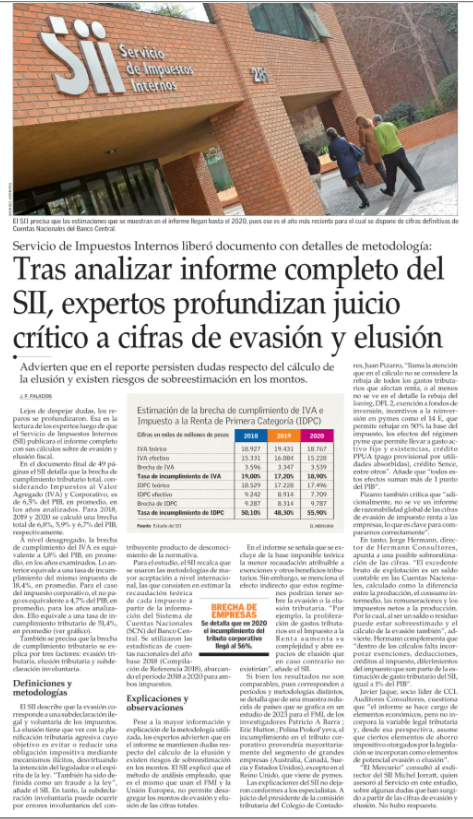
In the final 49-page document, the SII details that the total tax compliance gap, considering Value Added Tax (VAT) and Corporate Tax, averages 6.5% of GDP over the years analyzed. For 2018, 2019, and 2020, the total gap was estimated at 6.8%, 5.9%, and 6.7% of GDP, respectively.
At a disaggregated level, the VAT compliance gap is equivalent to 1.8% of GDP on average over the years examined. This corresponds to an average non-compliance rate of 18.4% for that tax. In the case of corporate tax, unpaid taxes are equivalent to 4.7% of GDP, on average for the analyzed years. This represents an average tax non-compliance rate of 51.4%.
It is also specified that the tax compliance gap is explained by three factors: tax evasion, tax avoidance, and unintentional underreporting.
Explanations and observations
Javier Jaque, Lead Partner at CCL Auditores Consultores, questions that “the report addresses economic elements but does not incorporate the legal tax variable and, from that perspective, assumes that certain tax savings mechanisms granted by legislation are included as elements of potential evasion or avoidance.”