
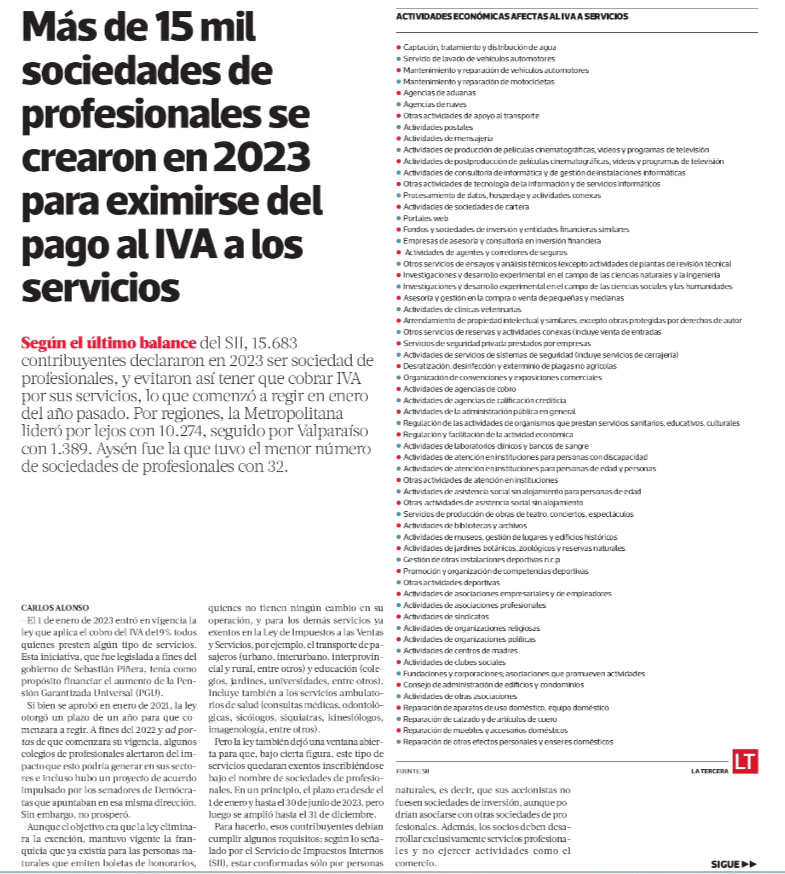
According to the latest SII report, 15,683 taxpayers declared themselves as Professional Service Companies in 2023. By region, the Metropolitan Region led by far with 10,274, followed by Valparaíso with 1,389. Aysén recorded the lowest number, with 32 such companies.
Read the article in La Tercera – Pulso.
On January 1, 2023, the law imposing a 19% VAT on all service providers came into force. This initiative, enacted toward the end of Sebastián Piñera’s administration, aimed to finance the increase of the Universal Guaranteed Pension (PGU).
Although approved in January 2021, the law granted a one-year period before entering into force. At the end of 2022, just before its implementation, several professional associations warned about its potential impact on their sectors, and even a legislative agreement proposal was introduced by senators from the Democrats party. However, it did not succeed.
While the objective was to eliminate the exemption, the law maintained the existing benefit for individuals issuing fee-based invoices, who experienced no change in their operations, as well as for other services already exempt under the VAT Law, such as passenger transport (urban, interurban, interprovincial, and rural, among others) and education (schools, kindergartens, universities, among others). It also includes outpatient healthcare services (medical consultations, dental services, psychologists, psychiatrists, kinesiology, imaging services, among others).
However, the law also left a “window” open allowing certain services to remain exempt by registering as Professional Service Companies. Initially, the deadline was from January 1 to June 30, 2023, but it was later extended to December 31.
To qualify, taxpayers had to meet certain requirements: according to the SII, they must be composed solely of individuals (no corporate shareholders), although they may associate with other professional companies. Additionally, partners must exclusively provide professional services and not engage in commercial activities.
Furthermore, all partners must practice the same profession or a related, similar, or complementary one. Partners contributing only capital are not allowed. If all requirements are met but the entity is not registered with the SII as a Professional Service Company, it may apply through a simplified procedure.
One of the main criticisms raised by advisors is that the business scope is limited to a single activity. For example, firms that simultaneously provide economic, legal, and judicial advisory services do not meet the SII’s definition of a professional company. As a result, they must either dissolve and form a new entity with aligned professions or continue operating and become subject to VAT.
Until 2022, services provided through corporations (SpA) or limited liability companies were not subject to VAT. Under the new legislation, maintaining those structures means becoming subject to VAT, creating a distortion between companies offering the same services.
Although the SII did not estimate how many companies would register as professional companies, it indicated that around 100,000 entities could potentially meet the requirements.
However, the final number was far below that estimate. According to the latest SII report, 15,683 taxpayers registered as Professional Service Companies in 2023 through the “Extraordinary Registry of Professional Service Companies.”
January 2023 recorded the highest number of registrations with 5,616, while September had the lowest with 396. Regionally, the Metropolitan Region led with 10,274 registrations, followed by Valparaíso with 1,389, while Aysén had the lowest with 32.
Among the services previously exempt from VAT that are now taxed include corporate consulting services (engineering, accounting, legal, among others), collection services, management and administrative services, design services, software development, audiovisual services, virtual office services, management services (within holding companies or for third parties), technical adaptation, software maintenance and support, pet care services, audiovisual production, and travel assistance services, among others.
Eliminating the exemption?
Tax experts offer differing views on whether this exemption should be removed. Some believe this “window” should remain permanently open, while others argue it should be eliminated entirely to ensure equal treatment across all service providers.
Among the first group is Cristián Mena, partner at Mena Alessandri & Asociados, who argues that “there is an unfair distortion, as a professional operating individually is exempt, but if they choose to work as part of a team, they become taxed, affecting the fundamental right of association. Professional service companies are formed to generate synergies and are legitimate; therefore, this ‘window’ should be extended indefinitely.”
On the opposite side is Jaime Preiss, Partner of Tax Legal Consulting at CCL Auditores Consultores, who argues that “there is a certain consensus that allowing professional service companies to remain VAT-exempt undermined the original objective of taxing all services, creating, among other issues, interpretative challenges regarding what constitutes professional services. Therefore, eliminating the exemption would make sense from a systemic perspective.”