

The event featured the participation of the National Chamber of Commerce, Services and Tourism of Chile, the University of Santiago of Chile, and the Institute of Tax and Financial Studies.
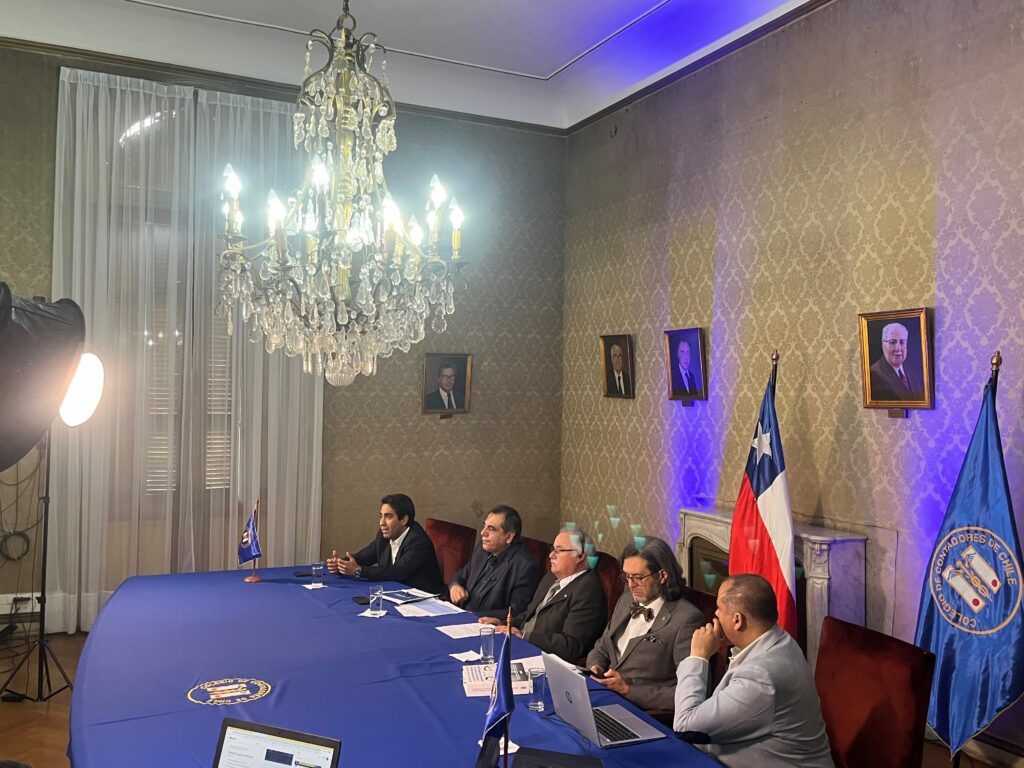
The debate over the fiscal pact presented by the government last week continues to generate discussion and create spaces for political, academic, and technical dialogue. The Chilean College of Accountants was no exception and organized a forum to further analyze the announcements of the proposal presented by the Ministry of Finance.
The president of the Tax Commission of the Chilean College of Accountants, Juan Pizarro, opened the presentations and highlighted that the government’s fiscal pact proposal expanded to include additional aspects beyond revenue collection. In this regard, he explained that “it now includes transparency from the fiscal authority; better use of public spending, which is essential in the current context; productivity; investment incentives closely linked to supporting economic growth; progressivity related to higher taxes; and a commitment to tax compliance aimed at combating evasion and avoidance.”
Regarding investment incentives, Javier Jaque, executive director of the Tax Studies Center of the ITF and Lead Partner at CCL Auditores Consultores, specified that “the government took note of the rejection of the original bill in the Chamber of Deputies and therefore included a modification that now introduces, after that rejection, a pro-growth agenda, meaning there are measures that can benefit SMEs and can be considered relevant.”
In this regard, Jaque added that “in general terms, companies currently considered SMEs are those up to 75,000 UF, and in this new proposal it is suggested to expand this to 100,000 UF. In other words, the idea is that more companies can be classified as SMEs so they can access the benefit of a lower tax rate. This would potentially allow benefits for those considered SMEs. The key question is how this will be achieved, but at least the spirit of this fiscal pact now incorporates pro-growth and pro-investment elements.”
For Christian Aste, president of the Tax Commission of the National Chamber of Commerce, it was also positive that the principles identified by the government in its fiscal pact proposal were generated from discussions with business associations: “I want to emphasize this, because there is work here that must be recognized, and that is that trade associations were listened to. Regardless of what may happen later, this is progress and should be highlighted because one of the principles incorporated into this tax pact is ‘legality’, which is relevant as it means that all elements of the tax obligation will be regulated by law, helping authorities avoid acting with discretion.”
However, for Germán Pinto, director of the Tax Specialization Programs at the University of Santiago, the tax dialogues that led to the government’s fiscal pact proposal “were not based on debate or consensus among participants, but rather on gathering information. Therefore, the 12 principles for a modern tax system were elements that were mentioned, but they were not a general agreement. In fact, there are several I could disagree with. It is not the voice of the tax dialogues that took place, yet they are being presented as something transversal, which is not the case.”
The Ministry of Finance has already begun discussions with political parties, but in the case of the opposition, UDI and Evópoli declined to participate in the fiscal pact meeting, so it had to be rescheduled for August 24 with parties represented in Congress.