
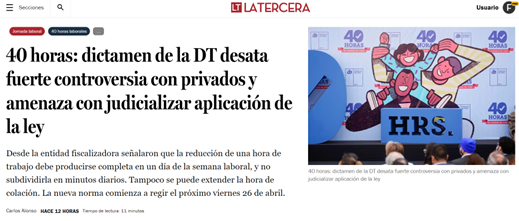
The supervisory authority stated that the reduction of one working hour must be applied entirely on one day of the workweek and cannot be split into daily minutes. Nor can the lunch break be extended. The new regulation comes into effect next Friday, April 26.
Read the article in La Tercera-Pulso.
Exactly one week remains before the law reducing the workweek to 40 hours comes into effect. In this first year, the workweek will decrease from 45 to 44 hours, marking the beginning of the new law that will gradually reduce working hours to 40 per week over a five-year period.
Thus, in 2026, weekly hours will decrease to 42 hours, and by 2028 the workweek will reach 40 hours. However, the law allows companies that wish to reduce working hours earlier, without waiting for the deadline, to do so.
Until now, the focus regarding the law’s entry into force had been on the new criteria established for Article 22, paragraph 2, as the grounds for exclusion from working hour limits were narrowed. However, this Thursday a new point of tension emerged between the government and the private sector.
The situation began after the Central Unitary Workers’ Union (CUT) alerted the Ministry of Labor to complaints from unions and workers regarding the formula some companies were planning to use to reduce working hours from 45 to 44.
According to CUT president David Acuña, companies were proposing to distribute the one-hour reduction into 12 minutes per day. In this way, over the five days of the week, the one-hour reduction would be completed. Another alternative mentioned was adding 12 minutes to the lunch break.
Given this situation, Labor Minister Jeannette Jara stated that there were doubts among workers, expressed through formal inquiries and social media, regarding how the first-hour reduction in the workday should be implemented.
As a result, the Labor Directorate (DT) issued a new ruling to clarify the interpretation being applied to the legislation.
In this regard, Labor Director Pablo Zenteno explained that the ruling clarified “a situation that was unclear regarding how the daily reduction in working hours should be applied. In that sense, we have established that the law is very clear regarding gradual implementation and proportionality rules, which must be mandatory for the employer when there is no agreement between the parties.”
The law and its interpretations
The DT ruling states that the third transitional article of Law No. 21,561 establishes that the adjustment of daily working hours to comply with the new weekly limits must be carried out by mutual agreement between the parties or through unions representing their members. In the absence of such agreement, the employer must adjust the workday by reducing its end proportionally across the different working days, taking into account the weekly distribution of working hours.
The ruling also concluded that, “where there is agreement, the adjustment of daily working hours may be carried out at the beginning or end of the workday. In such cases, the agreement must be in writing and must respect the maximum limit of 10 ordinary working hours per day.”
Finally, Doctrine No. 213/07 clarified that, in the absence of agreement, the employer must adjust the workday by reducing its end proportionally across the working days, considering the weekly distribution. Therefore, “it can be inferred that the legislator established the objective of adapting the daily workday to the new limits set in Article 22, paragraph 1 of the Labor Code and the first transitional article of Law No. 21,561, reducing it from 45 to 40 weekly hours, applicable both in cases of agreement and disagreement.”
Thus, according to the DT, in the absence of agreement, the rule mandates the reduction of working hours based on proportionality. Meanwhile, the first transitional article sets the minimum timing for implementing the reduction: at least one hour on April 26, 2024; two hours on April 26, 2026; and another two hours on April 26, 2028.
For the period between April 26, 2024, and April 25, 2026, the ruling states that, in the case of a Monday-to-Friday schedule, the employer must reduce at least one hour of the daily workday on one of the five working days.
Likewise, for a six-day workweek (Monday to Saturday), the ruling indicates that the employer must reduce at least 50 minutes on one day and the remaining 10 minutes on another day within the six working days.
Minister Jara explained that the 40-hour law “is highly valued and demanded by citizens. It was built on a tripartite agreement between employers, workers, and the government. Today, just before its implementation on April 26, we have identified concerns about how some intend to apply it through daily minute reductions. This is what the Labor Directorate ruling clarifies and limits.”
For his part, the Labor Director stated that the ruling “clarifies the specific formula employers must use to adjust the daily working schedule in order to achieve the weekly reduction when there is no agreement with workers or unions, in accordance with the provisions of Articles 1 and 3 of the transitional law, which establish rules of graduality and proportionality.”
Private sector confusion
This ruling was poorly received by the private sector. Both business associations and labor lawyers argue that the DT’s clarification contradicts the law itself and previous rulings, and some even consider it outright illegal.
One of the strongest criticisms came from María Teresa Vial, president of the Santiago Chamber of Commerce (CCS), who stated that “the DT interprets the reduction of the maximum weekly working hours restrictively, limiting it to a full one-hour reduction on a single day, even though the law itself does not establish such distinction.”
She also expressed concern that “this type of ruling is issued just one week before the law comes into force, even though it was enacted a year ago. In practice, companies have already analyzed their organizational structures, and this late ruling creates confusion and undermines prior planning.”
From the Sofofa, Rodrigo Mujica and Camila Valenzuela noted that “the ruling is surprising, first because it differs from what the law establishes and what was agreed upon during its legislative discussion.”
Industry representatives emphasize that “this is further aggravated by the fact that the ruling was issued just one week before its implementation. Many companies are already prepared, and this last-minute change may increase conflict between parties.”
They also warned of a “risk of judicialization due to such a last-minute change in criteria.”
José Pakomio, president of the National Chamber of Commerce (CNC), stated that “this interpretation does not consider the internal realities of companies or the complex adjustments required to comply with the new legal requirements without negatively affecting them or their workers.”
He added that “this could lead to greater judicialization, as restricting implementation options will make it harder to reach agreements between parties.”
From SMEs, Juan Pablo Swett, president of the National Multigremial, argued that “it was never discussed that annual reductions had to be implemented on a single day. This instruction fails to recognize the flexibility intended by the law.”
Jorge Welch, president of the Entrepreneurs Association, noted that “greater judicialization is expected when new and complex regulations are implemented without sufficient clarity, especially since SMEs often lack the resources to adapt.”
Labor experts
Labor experts have also criticized the ruling. Former Labor Director Mauricio Peñaloza stated that “this ruling contradicts the law, which clearly indicates that the reduction should be applied proportionally across working days, not concentrated on a single day.”
He added that “greater judicialization is likely, as companies sanctioned under this criterion will seek recourse in the courts.”
Marcelo Albornoz, also a former Labor Director, argued that “this is not a clarification but a modification, as previous rulings stated the opposite—that reductions should be distributed proportionally across the week.”
Santiago Guillén, a lawyer at Estudio Navarro, emphasized that “there is a real risk of judicialization, since most companies had already planned the reduction of working hours, and if such plans conflict with the DT’s new criteria, they may face penalties.”
Sebastián Parga, partner at Parga, Montes & Vasseur Labor Lawyers, added that “just one week before the law’s entry into force, the Labor Directorate announced an unexpected change in criteria, despite previously stating that reductions could be distributed in minutes across the workweek.”
A different perspective was offered by Carlos Tapia, Director of the Corporate Tax Area at CCL Auditores Consultores, who noted that “in any process of adapting to new labor regulations, differences arise between employers and workers, which naturally leads to an increase in both administrative and judicial actions.”
:contentReference[oaicite:0]{index=0}