
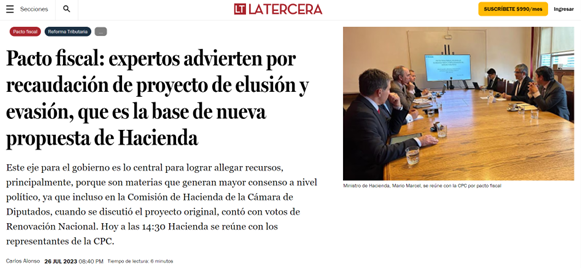
This pillar is central for the government to secure additional resources, mainly because these are areas that generate broader political consensus. Even within the Finance Committee of the Chamber of Deputies, when the original bill was discussed, it received votes from Renovación Nacional. Today at 2:30 PM, the Treasury will meet with representatives of the CPC.
Read the full article in La Tercera-Pulso.
The final stage to learn the details of the fiscal pact is approaching. On July 31, the Minister of Finance, Mario Marcel, will reveal the final content and the legislative timeline to be followed. In this context, one of the topics that has been most discussed in working groups with micro, small, and medium-sized enterprises, as well as with representatives of the Confederation of Production and Commerce (CPC), relates to the rules to combat tax avoidance and evasion.
On this front, the Treasury has been open to making modifications to the original proposal. Among the main changes proposed is the creation of an advisory council—composed of external individuals with expertise in tax matters—for the Director of the Internal Revenue Service (SII), which will issue an opinion on cases related to the General Anti-Avoidance Rule (NGA) brought before it. Its composition will be based on the advisory council of the Taxpayer Defense Office (Dedecon) and other similar bodies previously established.
Regarding the anonymous whistleblower, this legal figure will be created to allow individuals who provide information to authorities for the prosecution of tax crimes to be rewarded with a portion of the amounts collected. However, to prevent misuse, penalties for false reports will also be introduced.
Although tax experts believe the changes improve the original proposal, concerns remain focused on the anonymous whistleblower mechanism and, above all, on the level of revenue expected from these anti-avoidance and anti-evasion measures, which form the basis for raising additional resources under this new framework. According to estimates by the Treasury, these measures aim to generate revenue equivalent to 1.6% of Gross Domestic Product (GDP), approximately US$5.6 billion.
Experts’ views on the changes
Another expert who believes the adjustments improve the original proposal is Javier Jaque, partner in Tax Consulting at CCL Auditores Consultores, who notes that the existence of “an advisory council provides balance in the application of the rule, but its opinion should be binding and not remain merely as recommendations.”