
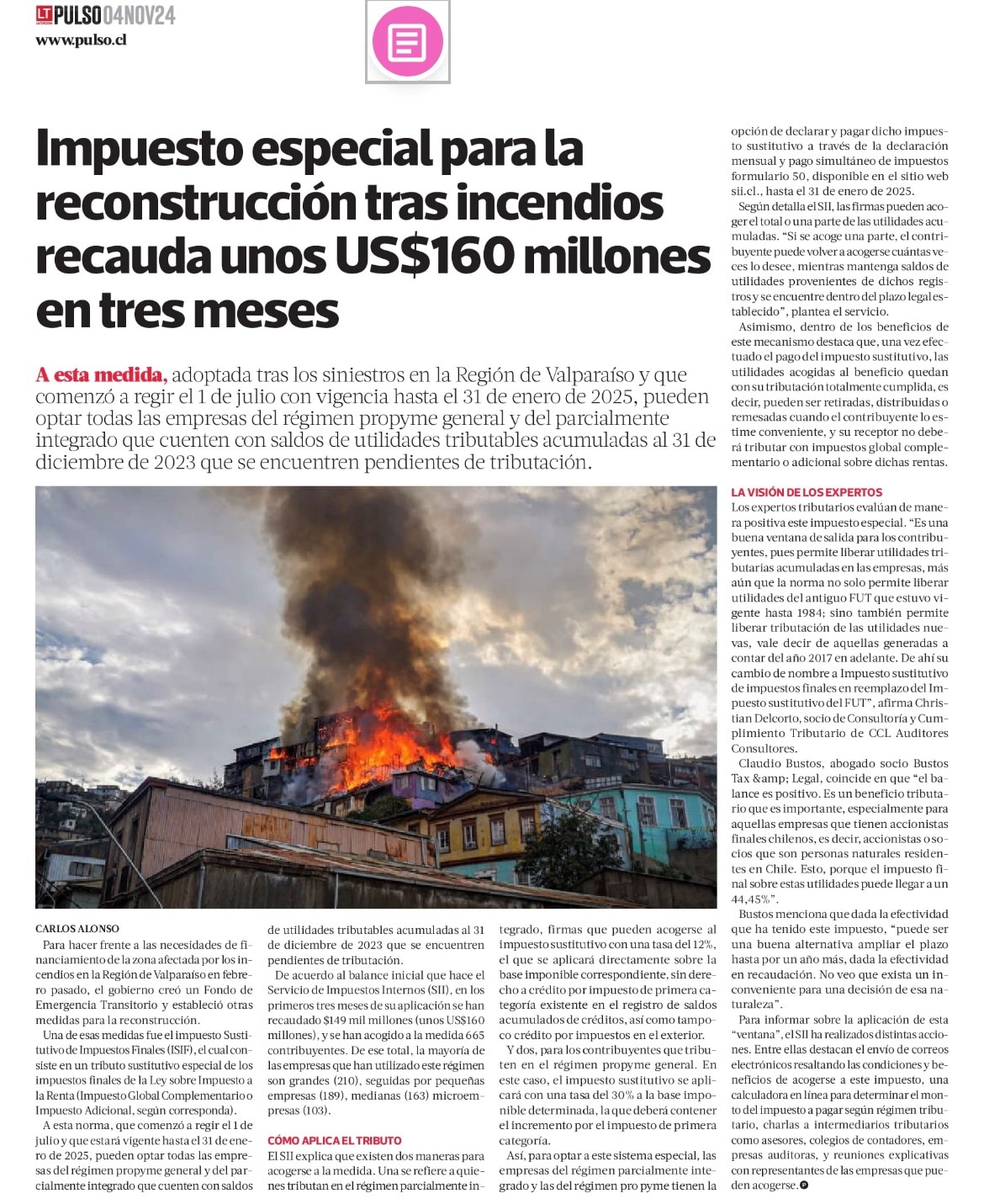
This measure, adopted following the wildfires in the Valparaíso Region and in effect from July 1 through January 31, 2025, is available to all companies under the general pro-SME regime and the partially integrated regime that have accumulated taxable profits as of December 31, 2023, pending taxation.
Read the article in La Tercera-Pulso.
To address the financing needs of the area affected by the wildfires in the Valparaíso Region last February, the government created a Temporary Emergency Fund and established other reconstruction measures.
One of these measures was the Substitute Tax on Final Taxes (ISIF), which consists of a special substitute tax for final taxes under the Income Tax Law (Global Complementary Tax or Additional Tax, as applicable).
This regulation, which came into effect on July 1 and will remain in force until January 31, 2025, is available to all companies under the general pro-SME regime and the partially integrated regime that have accumulated taxable profits as of December 31, 2023, pending taxation.
According to the initial assessment by the Internal Revenue Service (SII), in the first three months of its application, $149 billion (around US$160 million) has been collected, with 665 taxpayers opting into the measure. Of this total, most of the companies that have used this regime are large companies (210), followed by small (189), medium-sized (163), and microenterprises (103).
How the tax applies
The SII explains that there are two ways to opt into the measure. One applies to those taxed under the partially integrated regime, where companies can apply the substitute tax at a rate of 12%, which will be applied directly to the corresponding tax base, without the right to credit for first-category tax recorded in accumulated credit balances, nor for foreign tax credits.
Second, for taxpayers under the general pro-SME regime, the substitute tax will be applied at a rate of 30% to the determined tax base, which must include the gross-up for first-category tax.
Thus, to opt for this special system, companies under the partially integrated regime and the pro-SME regime may declare and pay this substitute tax through the monthly tax declaration and simultaneous payment using Form 50, available on the website sii.cl, until January 31, 2025.
According to the SII, companies may opt to include all or part of their accumulated profits. “If only part is included, the taxpayer may opt into the system as many times as desired, as long as they maintain profit balances from those records and remain within the legally established timeframe,” the agency states.
Additionally, one of the key benefits of this mechanism is that once the substitute tax has been paid, the profits covered by the benefit are considered fully taxed. In other words, they may be withdrawn, distributed, or remitted at the taxpayer’s discretion, and the recipient will not be subject to global complementary or additional taxes on those amounts.
Expert perspective
Tax experts view this special tax positively. “It is a good exit window for taxpayers, as it allows the release of accumulated taxable profits within companies. Moreover, the rule not only allows the release of profits from the old FUT that was in force until 1984, but also allows the release of taxation on newer profits—those generated from 2017 onward. Hence its name change to Substitute Tax on Final Taxes, replacing the Substitute Tax on FUT,” states Christian Delcorto, Partner of Tax Consulting and Compliance at CCL Auditores Consultores.
Claudio Bustos, partner and tax lawyer at Bustos Tax & Legal, agrees that “the overall assessment is positive. It is an important tax benefit, especially for companies whose ultimate shareholders are Chilean individuals, meaning shareholders or partners who are natural persons residing in Chile. This is because the final tax on these profits can reach up to 44.45%.”
Bustos adds that given the effectiveness of this tax, “it could be a good alternative to extend the deadline for another year, considering its effectiveness in revenue collection. I do not see any drawback to such a decision.”
To inform about the application of this “window,” the SII has carried out various actions. These include sending emails highlighting the conditions and benefits of opting into this tax, an online calculator to determine the amount payable according to the tax regime, seminars for tax intermediaries such as advisors, accounting associations, audit firms, and informational meetings with representatives of companies eligible to opt in.