
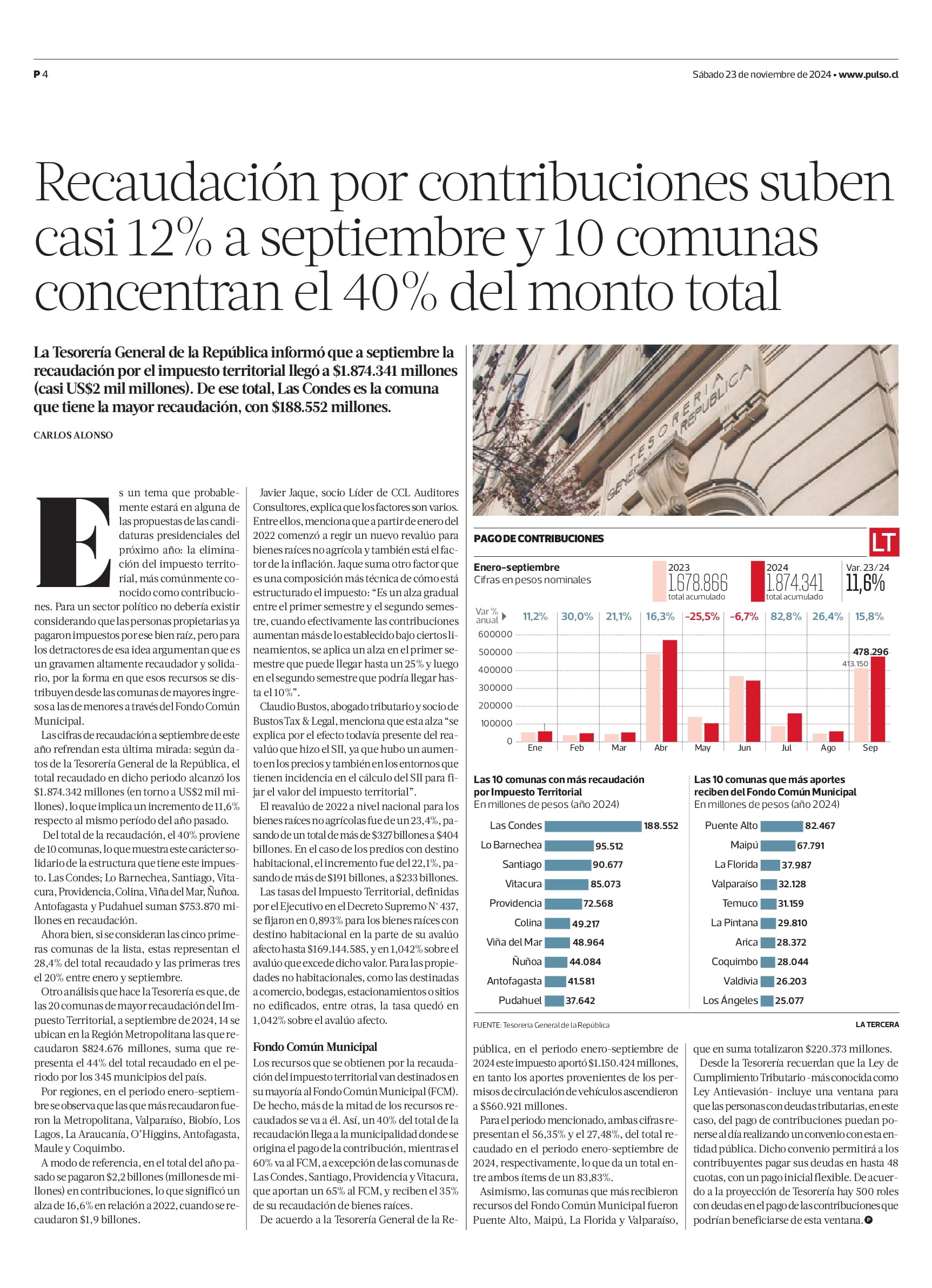
The General Treasury of the Republic reported that as of September, revenue from property tax reached $1,874,341 million (nearly US$2 billion). Of that total, Las Condes is the municipality with the highest revenue, with $188,552 million.
Read the full article in La Tercera-Pulso.
This is an issue that will likely appear in some of the proposals of next year’s presidential candidates: the elimination of the property tax, more commonly known as “contributions.” For one political sector, it should not exist since property owners have already paid taxes on that real estate. However, opponents argue that it is a highly effective and redistributive tax, given how these resources are distributed from higher-income municipalities to lower-income ones through the Municipal Common Fund.
The revenue figures as of September support this latter view: according to data from the General Treasury of the Republic, the total collected during that period reached $1,874,342 million (around US$2 billion), representing an 11.6% increase compared to the same period last year.
Of the total revenue, 40% comes from 10 municipalities, highlighting the redistributive nature of this tax structure. Las Condes; Lo Barnechea, Santiago, Vitacura, Providencia, Colina, Viña del Mar, Ñuñoa, Antofagasta, and Pudahuel together account for $753,870 million in revenue.
If we consider the top five municipalities on the list, they represent 28.4% of the total collected, and the top three account for 20% between January and September.
Another analysis by the Treasury shows that, among the 20 municipalities with the highest property tax revenue as of September 2024, 14 are located in the Metropolitan Region, collecting $824,676 million, which represents 44% of the total revenue collected during the period by the country’s 345 municipalities.
By region, between January and September, the highest revenues were collected in the Metropolitan Region, Valparaíso, Biobío, Los Lagos, La Araucanía, O’Higgins, Antofagasta, Maule, and Coquimbo.
As a reference, during last year a total of $2.2 trillion (millions of millions) was paid in property taxes, representing a 16.6% increase compared to 2022, when $1.9 trillion was collected.
Javier Jaque, Lead Partner at CCL Auditores Consultores, explains that several factors are involved. Among them, he mentions that a new reassessment for non-agricultural real estate came into effect in January 2022, along with inflation. Jaque adds another factor related to the technical structure of the tax: “There is a gradual increase between the first and second halves of the year. When contributions rise beyond certain thresholds, an increase of up to 25% may be applied in the first half and up to 10% in the second half.”
Claudio Bustos, tax lawyer and partner at Bustos Tax & Legal, notes that this increase “is explained by the ongoing effect of the reassessment carried out by the SII, since there was an increase in prices and in the surrounding factors that influence how the SII calculates the value of the property tax.”
The 2022 nationwide reassessment for non-agricultural real estate was 23.4%, increasing from more than $327 trillion to $404 trillion. In the case of residential properties, the increase was 22.1%, rising from more than $191 trillion to $233 trillion.
The Property Tax rates, defined by the Executive in Supreme Decree No. 437, were set at 0.893% for residential properties on the portion of their assessed value up to $169,144,585, and 1.042% on the value exceeding that amount. For non-residential properties, such as commercial properties, warehouses, parking lots, or undeveloped land, the rate was set at 1.042% on the assessed value.
Municipal Common Fund
Most of the resources obtained from property tax revenue are allocated to the Municipal Common Fund (FCM). In fact, more than half of the collected resources go to it. Thus, 40% of the total revenue goes to the municipality where the contribution is generated, while 60% goes to the FCM, except for the municipalities of Las Condes, Santiago, Providencia, and Vitacura, which contribute 65% to the FCM and retain 35% of their real estate revenue.
According to the General Treasury of the Republic, between January and September 2024, this tax contributed $1,150,424 million, while revenue from vehicle circulation permits reached $560,921 million.
For the period mentioned, these figures represent 56.35% and 27.48% of the total revenue collected between January and September 2024, respectively, totaling 83.83% between both items.
Likewise, the municipalities that received the most resources from the Municipal Common Fund were Puente Alto, Maipú, La Florida, and Valparaíso, which together totaled $220,373 million.
The Treasury also reminds that the Tax Compliance Law—better known as the Anti-Evasion Law—includes a window that allows individuals with tax debts, in this case property tax payments, to get up to date by entering into an agreement with this public entity. This agreement allows taxpayers to pay their debts in up to 48 installments, with a flexible initial payment. According to Treasury projections, there are 500 accounts with outstanding property tax debts that could benefit from this measure.