
Under the Tax Compliance Law, this obligation had been established as applying exclusively to bank cards, leaving prepaid cards excluded. This will now change. The proposal was incorporated into the miscellaneous bill that has already been approved by the Finance Committee of the Chamber of Deputies.
Read the article in La Tercera-Pulso.
To close all loopholes for avoidance, the Ministry of Finance included in a miscellaneous bill—bringing together provisions on various matters related to regulatory simplification and the promotion of economic activity—a modification to the recent anti-evasion law.
This rule seeks to obtain information on transactions exceeding 1,500 UF and on movements where, within the same day, week, or month, more than 50 deposits are made into accounts from 50 or more different individuals or entities, or where, within a semester, at least 100 deposits from 100 different individuals or entities are recorded (deposits – transfers).
Under the approved legislation, this obligation applied exclusively to bank cards, leaving prepaid cards excluded. As a result, the entities required to report certain operations are banks and savings and credit cooperatives subject to the supervision of the Financial Market Commission, as well as savings and credit cooperatives supervised by the Ministry of Economy, Development and Tourism. Insurance companies and private entities for the deposit and custody of securities must also report.
Now, with this amendment, the government includes prepaid cards, whether bank-issued or non-bank-issued. According to the proposed rule, “issuers of prepaid cards, whether bank or non-bank, will also be required to report.” It also adds that “information regarding prepaid cards, whether bank or non-bank, must likewise be reported.”
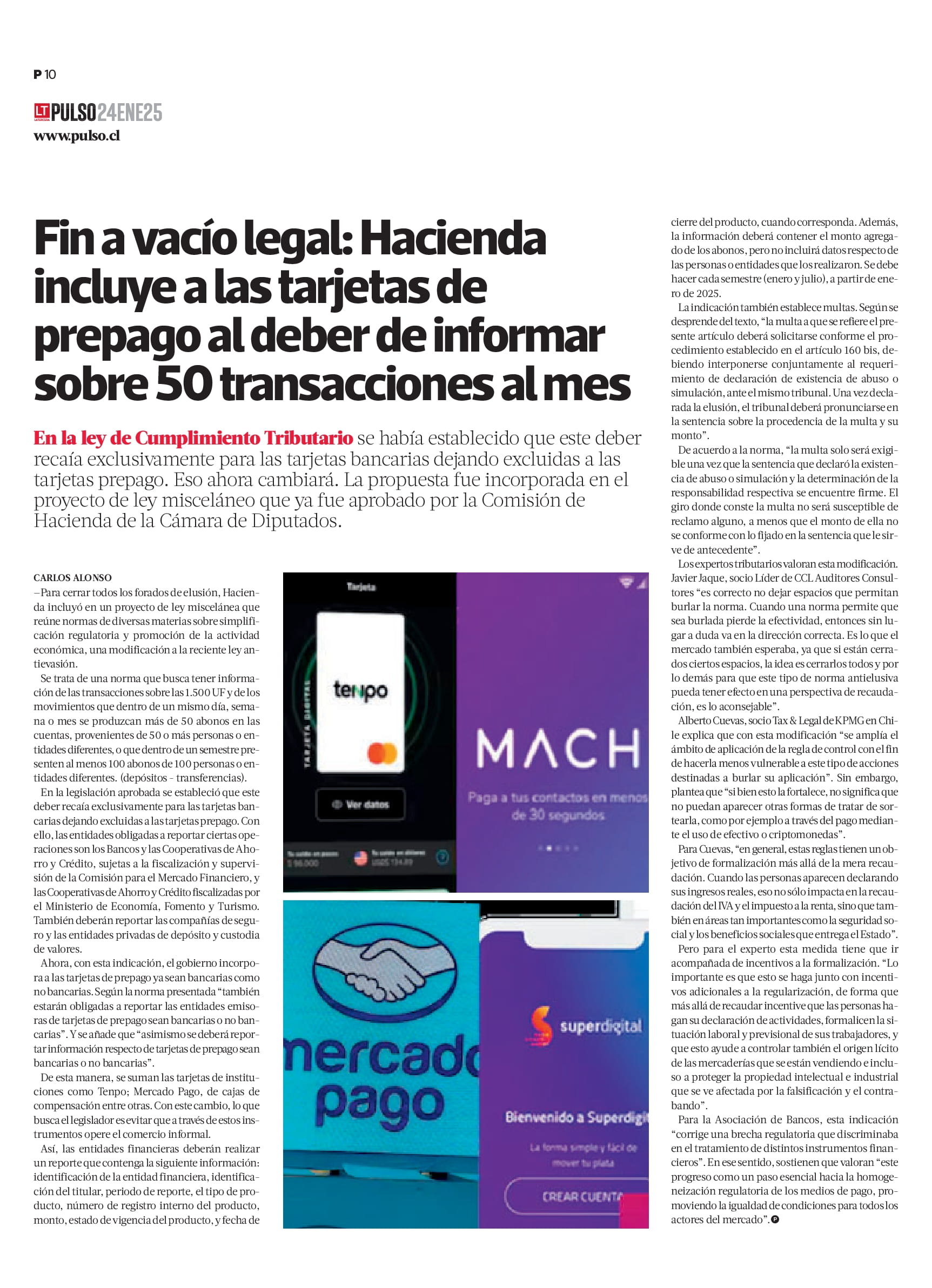
In this way, cards from institutions such as Tenpo, Mercado Pago, compensation funds, among others, are included. With this change, the legislator seeks to prevent informal commerce from operating through these instruments.
Thus, financial institutions must submit a report containing the following information: identification of the financial entity, identification of the account holder, reporting period, type of product, internal product registration number, amount, status of the product, and product closing date, where applicable. In addition, the information must include the aggregated amount of deposits, but will not include data regarding the individuals or entities who made them. This must be done every six months (January and July), starting in January 2025.
The amendment also establishes fines. According to the text, “the fine referred to in this article must be requested in accordance with the procedure set forth in Article 160 bis, and must be filed jointly with the request for a declaration of abuse or simulation before the same court. Once avoidance has been declared, the court must rule in its judgment on the applicability of the fine and its amount.”
According to the rule, “the fine will only be enforceable once the judgment declaring the existence of abuse or simulation and the determination of the corresponding liability becomes final. The issuance recording the fine will not be subject to any appeal, unless its amount does not conform to that established in the judgment serving as its basis.”
Tax experts value this amendment. Javier Jaque, Lead Partner at CCL Auditores Consultores, states that “it is correct not to leave room for circumventing the rule. When a rule allows itself to be bypassed, it loses effectiveness, so it undoubtedly moves in the right direction. It is also what the market expected, since if certain gaps are closed, the idea is to close them all, and furthermore, for this type of anti-avoidance rule to be effective from a revenue perspective, it is advisable.”
Alberto Cuevas, Tax & Legal partner at KPMG in Chile, explains that with this amendment “the scope of the control rule is expanded in order to make it less vulnerable to this type of action aimed at circumventing its application.” However, he notes that “although this strengthens it, it does not mean that other ways to bypass it may not emerge, such as through payments in cash or cryptocurrencies.”
For Cuevas, “in general, these rules have a formalization objective beyond mere revenue collection. When individuals declare their real income, it not only impacts VAT and income tax revenue, but also areas as important as social security and state-provided social benefits.”
However, for the expert, this measure must be accompanied by incentives for formalization. “What is important is that this is implemented together with additional incentives for regularization, so that beyond collecting revenue, it encourages individuals to declare their activities, formalize the labor and social security status of their workers, and helps control the lawful origin of the goods being sold, as well as protect intellectual and industrial property affected by counterfeiting and smuggling.”
For the Banking Association, this amendment “corrects a regulatory gap that discriminated in the treatment of different financial instruments.” In this regard, they state that they value “this progress as an essential step toward the regulatory harmonization of payment methods, promoting a level playing field for all market participants.”