
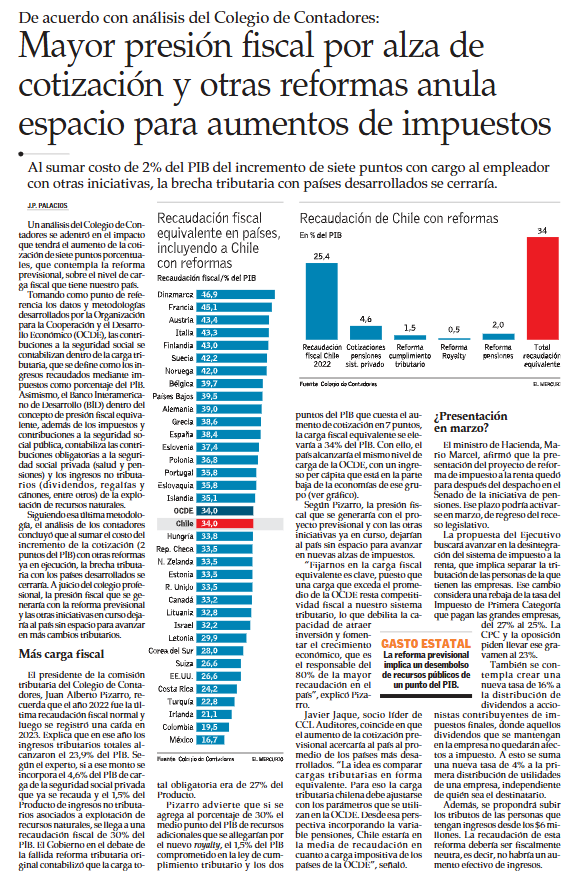
When adding the cost of 2% of GDP from the seven-point increase charged to employers, along with other initiatives, the tax gap with developed countries would close.
Read the article in El Mercurio.
An analysis by the Chilean College of Accountants examined the impact that the seven-percentage-point increase in contributions—contemplated in the pension reform—will have on the country’s overall tax burden.
Using data and methodologies developed by the Organisation for Economic Co-operation and Development (OECD), social security contributions are included within the tax burden, defined as revenue collected through taxes as a percentage of GDP. Likewise, the Inter-American Development Bank (IDB), under the concept of equivalent fiscal pressure, also includes mandatory private social security contributions (health and pensions) and non-tax revenues (such as dividends, royalties, and fees) derived from the exploitation of natural resources.
Following this latter methodology, the accountants’ analysis concluded that by adding the cost of the contribution increase (2% of GDP) to other reforms already in place, the tax gap with developed countries would be closed. In the opinion of the professional body, the fiscal pressure generated by the pension reform and other ongoing initiatives would leave the country with no room to advance further tax changes.
Higher fiscal burden
The president of the Tax Commission of the College of Accountants, Juan Alberto Pizarro, recalls that 2022 was the last year of normal fiscal revenue collection, followed by a decline in 2023. He explains that total tax revenues reached 23.9% of GDP that year. According to the expert, if this figure is combined with the 4.6% of GDP from private social security contributions already collected, and 1.5% of GDP from non-tax revenues related to natural resource exploitation, total fiscal revenue reaches 30% of GDP. The government, during the debate on the failed original tax reform, estimated that total mandatory burden stood at 27% of GDP.
Pizarro warns that if the 30% figure is increased by the additional 0.5% of GDP from the new royalty, the 1.5% of GDP committed under the tax compliance law, and the 2% of GDP cost of the seven-point contribution increase, the equivalent fiscal burden would rise to 34% of GDP. This would place the country at the same level as OECD countries, despite having a per capita income at the lower end of that group (see chart).
According to Pizarro, the fiscal pressure generated by the pension reform and other ongoing initiatives would leave the country with no room for further tax increases.
“Focusing on equivalent fiscal burden is key, since exceeding the OECD average reduces the tax competitiveness of our system, weakening the country’s ability to attract investment and promote economic growth, which accounts for 80% of increased tax revenue,” he explained.
Javier Jaque, Managing Partner of CCL Auditores Consultores, agrees that the increase in pension contributions would bring the country closer to the average of developed economies. “The idea is to compare tax burdens on an equivalent basis. To do so, Chile’s tax burden must be adjusted using OECD parameters. From that perspective, incorporating the pension variable, Chile would be at the average level of tax revenue among OECD countries,” he stated.
Presentation in March?
The Minister of Finance, Mario Marcel, stated that the presentation of the income tax reform bill will take place after the Senate processes the pension reform initiative. This timeline could begin in March, following the legislative recess.
The government’s proposal aims to move toward a de-integrated income tax system, separating the taxation of individuals from that of corporations. This change includes a reduction in the First Category Tax rate paid by large companies, from 27% to 25%. The Confederation of Production and Commerce (CPC) and opposition groups are calling for a further reduction to 23%.
The proposal also includes the creation of a new 16% tax rate on dividend distributions to shareholders subject to final taxes, while dividends retained within the company would not be taxed. Additionally, a new 4% rate would apply to the first distribution of profits, regardless of the recipient.
Furthermore, it proposes increasing taxes on individuals earning more than $6 million. The reform is expected to be fiscally neutral, meaning it would not result in a net increase in government revenue.