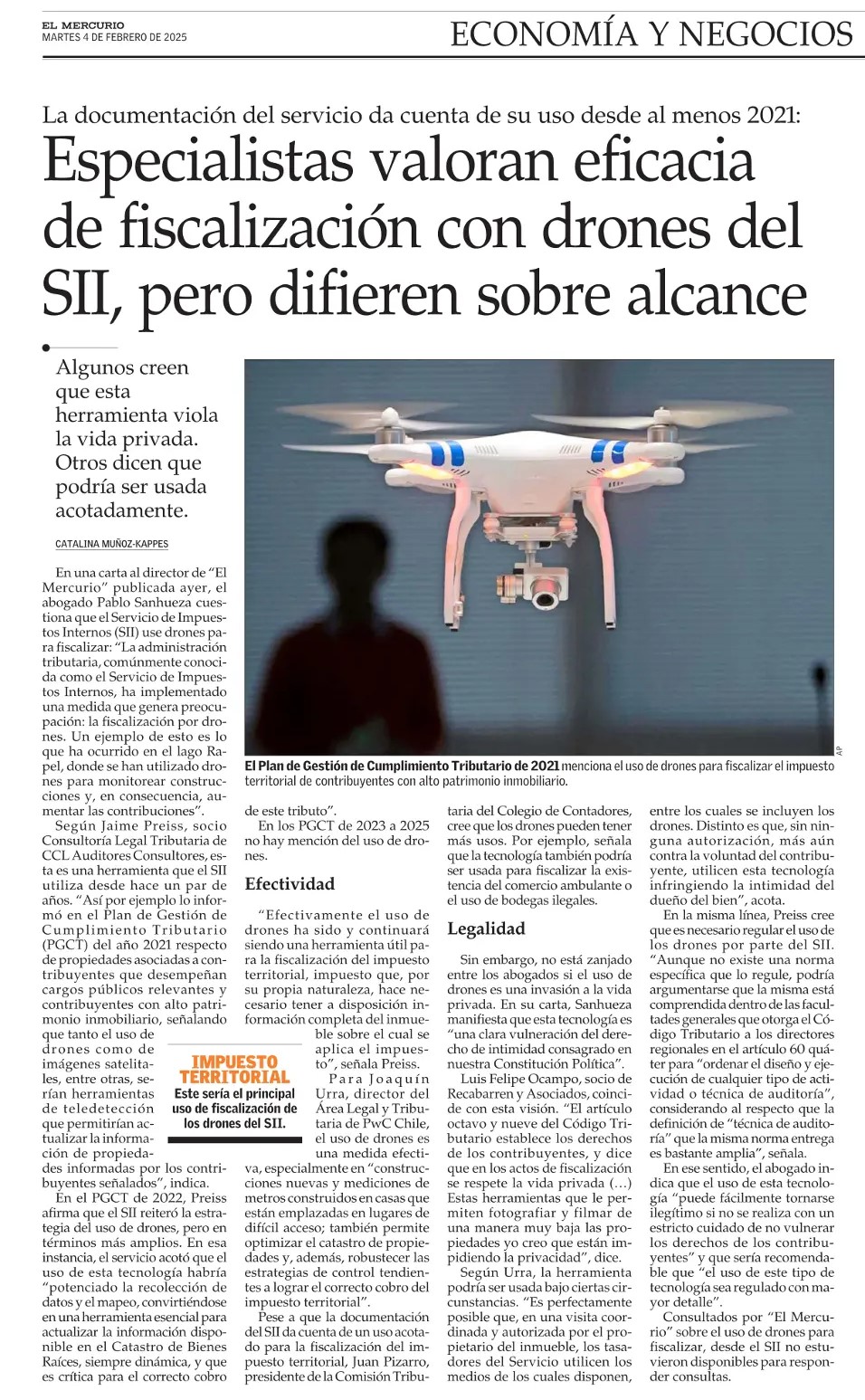
Some believe this tool violates privacy. Others say it could be used in a limited manner.
Read the article in El Mercurio.
In a letter to the editor of El Mercurio published yesterday, lawyer Pablo Sanhueza questioned the use of drones by the Internal Revenue Service (SII) for auditing: “The tax authority, commonly known as the Internal Revenue Service, has implemented a measure that raises concern: auditing through drones. An example of this is what has occurred at Lake Rapel, where drones have been used to monitor constructions and, consequently, increase property taxes.”
According to Jaime Preiss, Partner in Legal Tax Consulting at CCL Auditores Consultores, this is a tool that the SII has been using for several years. “For example, this was reported in the 2021 Tax Compliance Management Plan (PGCT) regarding properties associated with taxpayers holding relevant public positions and taxpayers with high real estate wealth, stating that both the use of drones and satellite imagery, among others, would be remote sensing tools that allow updating property information reported by such taxpayers,” he explains.
In the 2022 PGCT, Preiss notes that the SII reiterated the drone strategy, but in broader terms. At that time, the agency indicated that the use of this technology had “enhanced data collection and mapping, becoming an essential tool to update the Real Estate Registry, which is constantly evolving and critical for the proper collection of this tax.”
In the PGCTs from 2023 to 2025, there is no mention of drone usage.
Effectiveness
“Indeed, the use of drones has been and will continue to be a useful tool for auditing property tax, which by its very nature requires having complete information about the property to which the tax applies,” states Preiss.
For Joaquín Urra, Director of the Legal and Tax Area at PwC Chile, the use of drones is an effective measure, especially in “new constructions and the measurement of built square meters in homes located in hard-to-access areas; it also helps optimize the property registry and strengthen control strategies aimed at ensuring proper property tax collection.”
Although SII documentation indicates a limited use for property tax audits, Juan Pizarro, president of the Tax Commission of the Chilean College of Accountants, believes drones could have broader applications. For example, he suggests that the technology could also be used to monitor informal street commerce or the use of illegal storage facilities.
Legality
However, there is no consensus among lawyers as to whether the use of drones constitutes an invasion of privacy. In his letter, Sanhueza argues that this technology represents “a clear violation of the right to privacy enshrined in our Constitution.”
Luis Felipe Ocampo, partner at Recabarren & Asociados, shares this view. “Articles 8 and 9 of the Tax Code establish taxpayers’ rights, stating that during audits, privacy must be respected (…) These tools, which allow photographing and filming properties from a very close range, in my opinion, undermine privacy,” he says.
According to Urra, the tool could be used under certain circumstances. “It is entirely possible that, during a coordinated and authorized visit by the property owner, SII appraisers use the tools available to them, including drones. It is different, however, if this technology is used without authorization, especially against the taxpayer’s will, thereby infringing on the owner’s privacy,” he adds.
In the same vein, Preiss believes it is necessary to regulate the use of drones by the SII. “Although there is no specific regulation governing this, it could be argued that it falls within the general powers granted by the Tax Code to regional directors under Article 60 quater to ‘order the design and execution of any type of audit activity or technique,’ considering that the definition of ‘audit technique’ provided by the same rule is quite broad,” he explains.
In this regard, the lawyer notes that the use of this technology “can easily become illegitimate if it is not carried out with strict care to avoid violating taxpayers’ rights,” and that it would be advisable for “the use of this type of technology to be more specifically regulated.”
When consulted by El Mercurio about the use of drones for auditing, the SII declined to comment.