According to the SII, all operations carried out with these aircraft have the necessary authorizations, and they highlighted the increase in municipal revenues that this has generated.
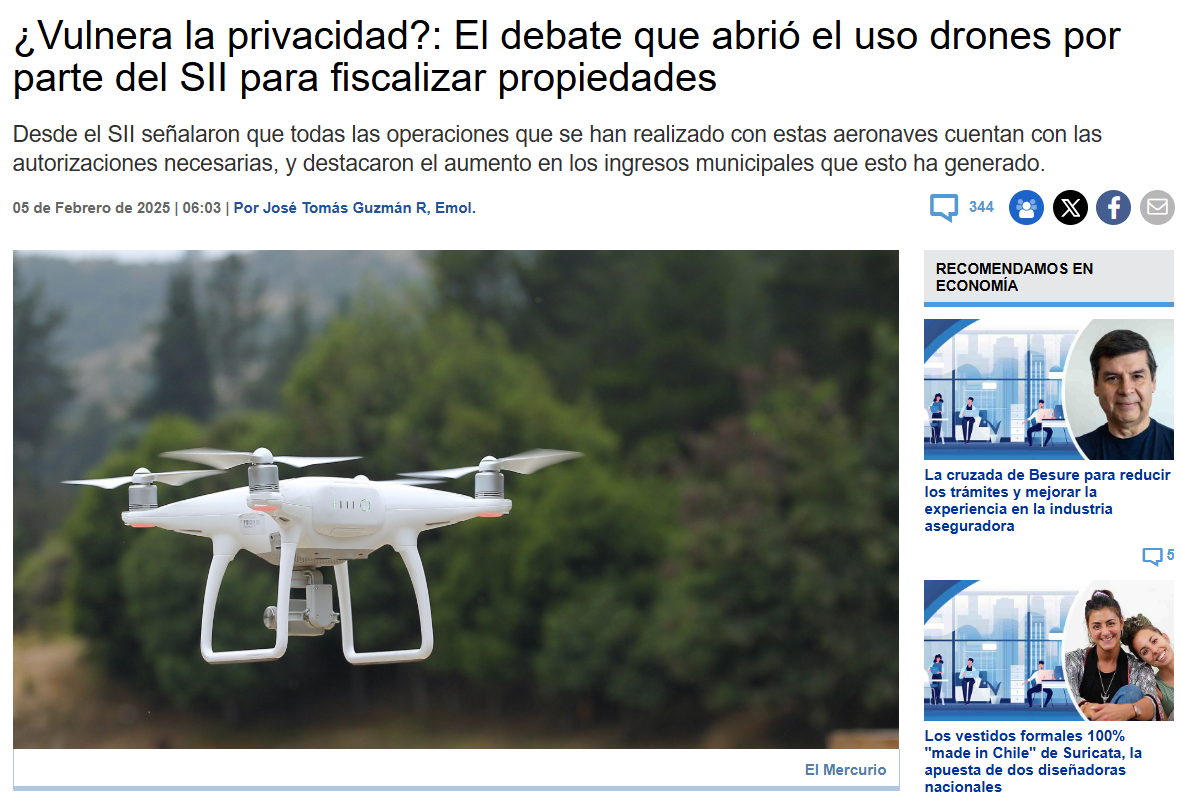
In recent days, a debate has emerged regarding the practice of auditing properties using drones by the Internal Revenue Service (SII). This is a measure the agency began implementing in 2021, with the main objective of monitoring potential non-compliance in the payment of property taxes.
In a letter published yesterday in El Mercurio, lawyer Pablo Sanhueza questioned the SII’s use of drones for audits, raising two issues: a potential violation of the right to privacy and a possible lack of efficiency in municipal Works Departments.
“The Internal Revenue Service (SII) has implemented a measure that raises concern: auditing through drones. An example of this is what has occurred at Lake Rapel, where drones have been used to monitor constructions and, consequently, increase property taxes,” he wrote.
For experts, this situation poses a significant challenge in terms of privacy and fundamental rights.
For example, Diego Messen, partner at Moraga & Cía, told Emol that the SII can only use tools granted by current legislation to exercise its audit powers, and if it exceeds those powers, it could be considered an arbitrary or illegal act.
However, he noted that “historically, it has not been unusual for the SII, under the pretext of improving oversight, to resort to tools beyond its scope of authority, which has caused conflicts between individuals and the administration.”
To determine whether this action violates the right to privacy, Messen explained that the principle of legality must be applied. If the law allows it, the act is lawful; otherwise, “we enter a gray area of potentially abusive use of legislative tools, which could be challenged by a taxpayer.”
Jaime Preiss, Partner in Legal Tax Consulting at CCL Auditores Consultores, told El Mercurio that this is a tool the SII has used for several years. “It has been and will continue to be a useful tool for auditing property tax, which by its nature requires complete information about the property on which the tax is applied.”
Meanwhile, Óliver Ortiz, Legal Manager at Deloitte, believes that surveillance using technological tools such as drones poses a risk of violating constitutional guarantees that protect the right to privacy.
“These recordings may include images of identified or identifiable individuals, as well as their personal data, all belonging to their private sphere,” Ortiz noted.
In addition to a potential violation of privacy, the Deloitte legal manager added that it could also constitute an infringement related to the processing of biometric data (such as facial features captured in surveillance recordings), unless there is explicit consent from the data subject.
In the same vein, Michel Aguilera, Director of Litigation and Disputes at Cabello Abogados, stated that one of the main issues is that drones have the potential to capture images of personal activities unrelated to the specific audit purpose, without the owners’ consent, posing a risk of intrusion into private life.
Thus, Aguilera indicated that the use of this technology should be strictly limited to its audit purpose, avoiding the capture of images inside properties without proper authorization from the owner or a court order.
SII defends the measure
In response to allegations of potential privacy violations, the SII stated that before implementing the measure, “the applicable regulations regarding the use and operation of remotely piloted aircraft were reviewed, as well as the feasibility of using the information obtained from their flights, to ensure that the operation complied with all relevant regulations.”
They also explained that the General Directorate of Civil Aviation (DGAC) is the entity responsible for regulating and supervising drone activity. “These regulations establish a series of requirements that must be met by operators, pilots, and aircraft, both before and during operation.”
“Therefore, all operations carried out since 2021 have the necessary authorizations,” the agency emphasized.
Regarding the results of these drone-based audits, the SII stated that more than 70,000 hectares have been flown over, “resulting in more than 2,300 cadastral updates and an increase in annual property tax assessments of approximately $3.1 billion, directly benefiting municipalities.”
Finally, the agency clarified that it does not own drones and that “since 2021, the SII has conducted three public tenders through the Mercado Público platform, with the third currently in full operation.”