
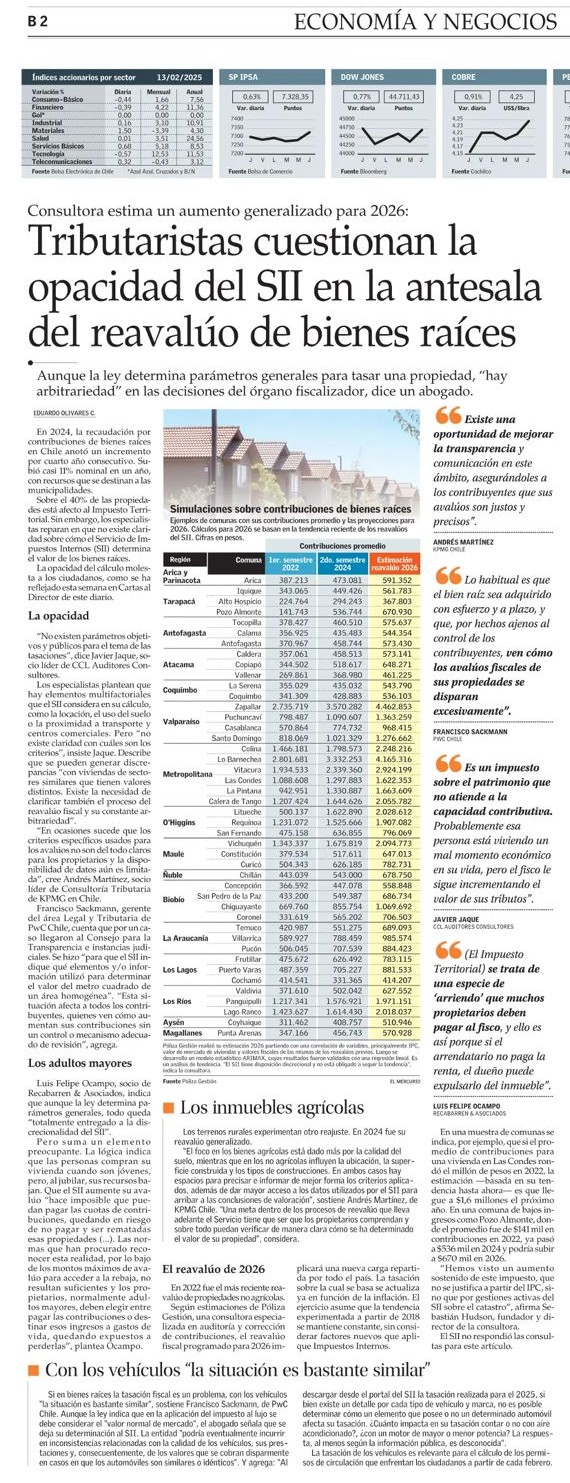
Although the law establishes general parameters for property valuation, “there is arbitrariness” in the decisions of the tax authority, says a lawyer.
Read the full article in El Mercurio.
In 2024, property tax revenue in Chile recorded an increase for the fourth consecutive year. It rose by nearly 11% in nominal terms in one year, with funds allocated to municipalities.
More than 40% of properties are subject to property tax. However, specialists note that there is no clarity on how the Internal Revenue Service (SII) determines real estate values.
The opacity of the calculation has frustrated citizens, as reflected this week in Letters to the Editor of this newspaper.
Opacity
“There are no objective and public parameters for property valuations,” says Javier Jaque, Managing Partner of CCL Auditores Consultores.
Experts point out that the SII considers multifactor elements in its calculations, such as location, land use, and proximity to transportation and commercial centers. But “there is no clarity regarding the criteria used,” insists Jaque. He describes that discrepancies may arise “between homes in similar areas that have different valuations. There is a need to clarify the fiscal reassessment process and its ongoing arbitrariness.”
“Sometimes the specific criteria used for valuations are not entirely clear to property owners, and the availability of data remains limited,” says Andrés Martínez, Head of Tax Consulting at KPMG in Chile.
Francisco Sackmann, manager of the Legal and Tax area at PwC Chile, explains that in one case they reached the Council for Transparency and judicial courts. This was done “to require the SII to indicate which elements and/or information it used to determine the value per square meter of a homogeneous area.” “This situation affects all taxpayers, who see their property taxes increase without an adequate control or review mechanism,” he adds.
Older adults
Luis Felipe Ocampo, partner at Recabarren & Asociados, states that although the law establishes general parameters, everything is “ultimately left to the discretion of the SII.”
He adds a concerning element. The logic is that people purchase their homes when they are young, but upon retirement, their income decreases. If the SII increases the valuation, “it makes it impossible for them to pay property tax installments, putting them at risk of default and having their properties auctioned (…). The rules that attempt to recognize this reality, due to the low maximum valuation thresholds to access reductions, are insufficient, and property owners—usually older adults—must choose between paying property taxes or using those funds for living expenses, leaving them exposed to losing their homes,” Ocampo explains.
The 2026 reassessment
The most recent reassessment of non-agricultural properties took place in 2022.
According to estimates by Póliza Gestión, a consulting firm specializing in property tax audits and corrections, the fiscal reassessment scheduled for 2026 will imply a new burden distributed across the country. The valuation base is already adjusted according to inflation. The exercise assumes that the trend observed since 2018 will remain constant, without considering new factors that the SII may apply.
In a sample of municipalities, for example, if the average property tax for a home in Las Condes was around $1 million in 2022, the estimate—based on its current trend—is that it could reach $1.6 million next year. In a lower-income municipality such as Pozo Almonte, where the average was $141,000 in property taxes in 2022, it already rose to $536,000 in 2024 and could reach $670,000 in 2026.
“We have seen a sustained increase in this tax, which is not justified by inflation alone, but rather by active management by the SII over the property registry,” says Sebastián Hudson, founder and director of the consulting firm.
The SII did not respond to inquiries for this article.
“There is an opportunity to improve transparency and communication in this area, ensuring taxpayers that their valuations are fair and accurate.”
Andrés Martínez
KPMG CHILE
“Typically, real estate is acquired with effort and over time, and due to factors beyond taxpayers’ control, they see the fiscal valuations of their properties increase excessively.”
Francisco Sackmann
PWC CHILE
“It is a tax on wealth that does not consider the taxpayer’s ability to pay. That person may be going through a difficult financial period, yet the government continues to increase their tax burden.”
Javier Jaque
CCL AUDITORES CONSULTORES
“(The Property Tax) is a kind of ‘rent’ that many property owners must pay to the government, because if a tenant does not pay rent, the owner can evict them from the property.”
Luis Felipe Ocampo
RECABARREN & ASOCIADOS
Agricultural properties
Rural land undergoes a different adjustment. In 2024, a general reassessment was carried out.
“The focus on agricultural properties is more related to soil quality, while for non-agricultural properties factors such as location, built surface area, and types of construction are more relevant. In both cases, there is room to better define and communicate the criteria applied, as well as to provide greater access to the data used by the SII to reach valuation conclusions,” says Andrés Martínez of KPMG Chile. “One of the goals of reassessment processes should be for property owners to understand and, above all, clearly verify how the value of their property has been determined.”
For vehicles, “the situation is quite similar”
If fiscal valuation is an issue for real estate, for vehicles “the situation is quite similar,” says Francisco Sackmann of PwC Chile. Although the law states that the “normal market value” must be considered when applying the luxury tax, the determination is left to the SII.
The authority “could potentially incur inconsistencies related to vehicle quality, features, and consequently, the differing values charged in cases where cars are similar or identical.” He adds: “When downloading the valuation from the SII portal for 2025, although there is a breakdown by vehicle type and brand, it is not possible to determine how a specific feature affects its valuation. How much does having or not having air conditioning impact the valuation? What about engine power? The answer, at least based on public information, is unknown.”
Vehicle valuation is relevant for calculating circulation permits that citizens must pay starting each February.