
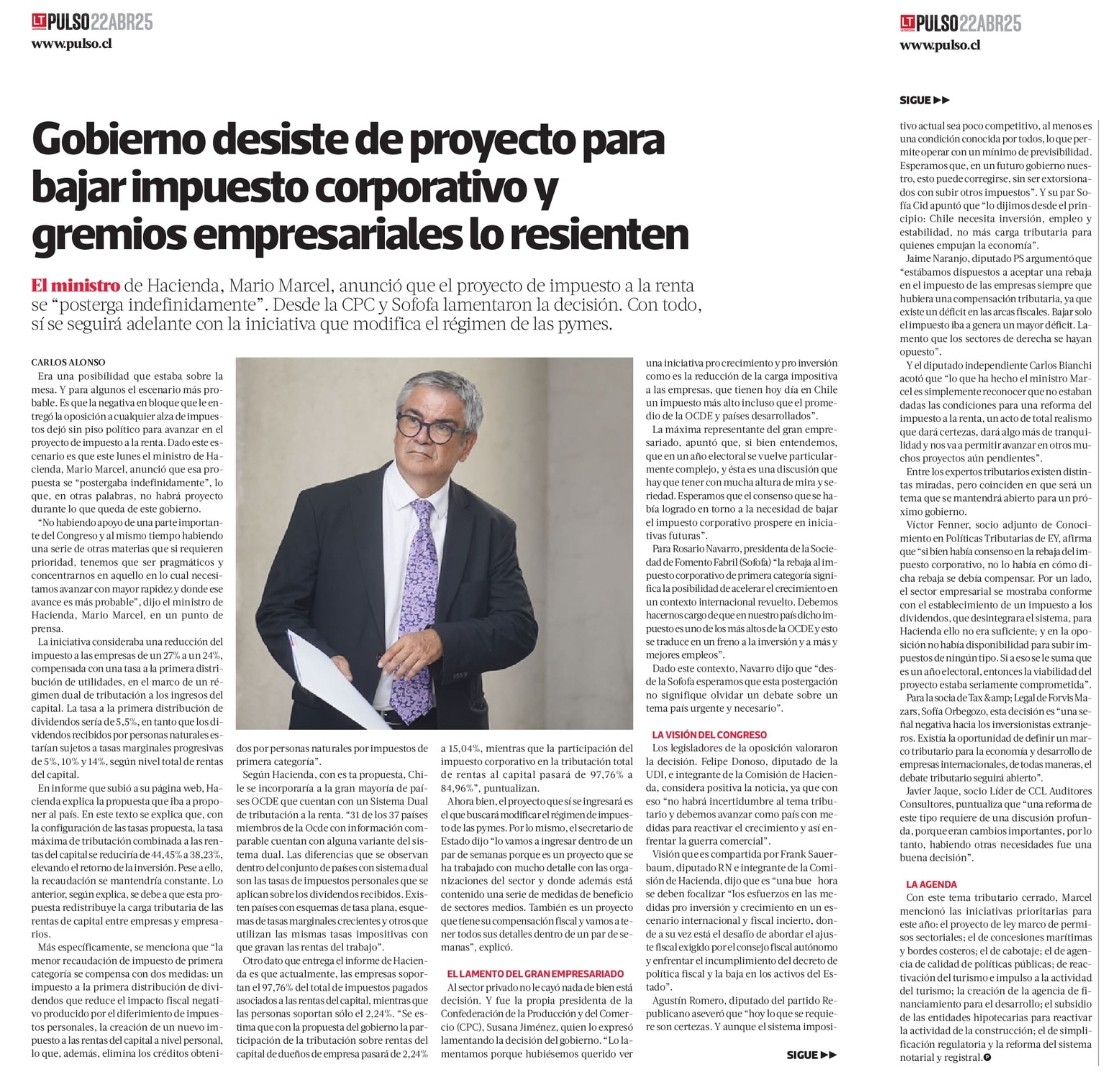
Finance Minister Mario Marcel announced that the income tax reform bill will be “indefinitely postponed.” Both the CPC and Sofofa expressed regret over the decision. However, the initiative to modify the SME tax regime will still move forward.
Read the article in La Tercera-Pulso.
It was a possibility that had been on the table—and for some, the most likely scenario. The opposition’s unified rejection of any tax increase left the income tax reform project without political support. Given this context, on Monday Finance Minister Mario Marcel announced that the proposal would be “indefinitely postponed,” meaning there will be no bill during the remainder of this administration.
“Without the support of a significant portion of Congress, and with other matters requiring priority, we must be pragmatic and focus on areas where progress is both necessary and more likely,” said Finance Minister Mario Marcel during a press briefing.
The initiative included a reduction in the corporate tax rate from 27% to 24%, offset by a tax on the first distribution of profits, within a dual system of capital income taxation. The tax on the first dividend distribution would be 5.5%, while dividends received by individuals would be subject to progressive marginal rates of 5%, 10%, and 14%, depending on total capital income.
In a report published on its website, the Ministry of Finance detailed the proposal it intended to present. It explained that, under the proposed structure, the maximum combined tax rate on capital income would decrease from 44.45% to 38.23%, thereby increasing investment returns. Despite this, tax revenue would remain stable, as the proposal redistributes the tax burden on capital income between companies and business owners.
More specifically, it notes that “the reduction in First Category tax revenue would be offset by two measures: a tax on the first distribution of dividends, which reduces the negative fiscal impact caused by the deferral of personal taxes, and the creation of a new tax on capital income at the individual level, which also eliminates tax credits obtained by individuals from First Category taxes.”
According to the Ministry, this proposal would align Chile with the majority of OECD countries that have some form of dual income tax system. “31 of the 37 OECD countries with comparable data have some variation of the dual system. Differences lie in the personal tax rates applied to dividends, with some using flat rates, others progressive marginal rates, and some applying the same rates used for labor income.”
Another point highlighted in the report is that currently companies bear 97.76% of total taxes associated with capital income, while individuals bear only 2.24%. “It is estimated that under the government’s proposal, the share of taxation on capital income borne by business owners would increase from 2.24% to 15.04%, while the share of corporate tax in total capital income taxation would decrease from 97.76% to 84.96%.”
However, the bill that will move forward is the one aimed at modifying the tax regime for SMEs. In this regard, the minister stated: “We will submit it in a couple of weeks, as it has been carefully developed with sector organizations and includes a series of measures benefiting middle-income groups. It also has fiscal compensation, and we will provide full details soon.”
Business sector reaction
The private sector reacted negatively to the decision. The president of the Confederation of Production and Commerce (CPC), Susana Jiménez, expressed regret, stating: “We regret this decision because we would have liked to see a pro-growth, pro-investment initiative such as reducing the tax burden on companies, which in Chile is currently higher than the OECD average and that of developed countries.”
She added that, although it is understood that in an election year discussions become more complex, this is a matter that requires serious and forward-looking debate. “We hope that the consensus reached around the need to reduce the corporate tax rate will materialize in future initiatives.”
For Rosario Navarro, president of the Society of Industrial Development (Sofofa), “lowering the corporate tax rate creates the opportunity to accelerate growth in a turbulent global context. We must recognize that in our country this tax is among the highest in the OECD, which ultimately acts as a brake on investment and job creation.”
In this context, Navarro stated that “we hope this postponement does not mean abandoning the debate on an urgent and necessary national issue.”
Congress perspective
Opposition lawmakers welcomed the decision. Felipe Donoso, UDI congressman and member of the Finance Committee, considered it positive, as “it removes uncertainty around tax matters and allows the country to move forward with measures to reactivate growth and face global trade challenges.”
This view was shared by Frank Sauerbaum, RN congressman and also a member of the Finance Committee, who described it as “a good decision” and emphasized the need to focus efforts on pro-investment and growth measures in a complex international and fiscal context.
Agustín Romero, congressman from the Republican Party, stated that “what is needed today is certainty. Even if the current tax system is not competitive, it is at least known and allows for some level of predictability.” Meanwhile, congresswoman Sofía Cid added that “Chile needs investment, jobs, and stability—not higher tax burdens for those driving the economy.”
Jaime Naranjo, PS congressman, argued that “we were willing to accept a reduction in corporate tax as long as there was fiscal compensation, given the existing deficit. Reducing the tax alone would increase the deficit. I regret that right-wing sectors opposed this.”
Independent congressman Carlos Bianchi added that “what Minister Marcel has done is acknowledge that the conditions were not in place for a tax reform, a realistic decision that provides certainty and allows progress on other pending initiatives.”
Among tax experts, there are differing views, but there is consensus that the issue will remain open for the next administration.
Víctor Fenner, Associate Partner at EY, noted that “while there was agreement on reducing corporate tax, there was no consensus on how to offset the reduction. The business sector supported a dividend tax, but for the Ministry of Finance this was insufficient, and the opposition was unwilling to approve any tax increases. Combined with the election year, the viability of the project was severely limited.”
For Sofía Orbegozo, partner at Forvis Mazars, the decision is “a negative signal to foreign investors. There was an opportunity to establish a clear tax framework for the economy and international business development. In any case, the tax debate will remain open.”
Javier Jaque, Managing Partner of CCL Auditores Consultores, stated that “a reform of this type requires in-depth discussion, as it involved significant changes. Therefore, given other priorities, it was a good decision.”
Agenda
With this tax issue closed, Marcel outlined the government’s priority initiatives for the year: the framework law for sectoral permits; maritime concessions and coastal development; cabotage; the public policy quality agency; tourism reactivation measures; the creation of a development financing agency; mortgage subsidies to reactivate construction; regulatory simplification; and reform of the notarial and registry system.