
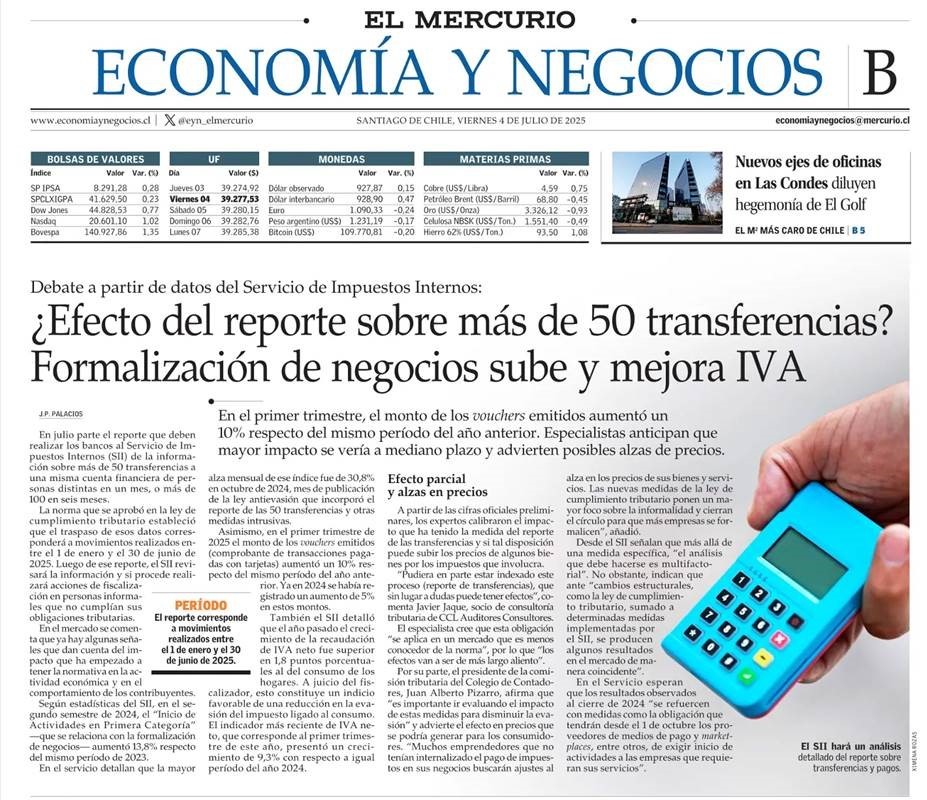
In the first quarter, the amount of vouchers issued increased by 10% compared to the same period the previous year. Experts anticipate that the greater impact will be seen in the medium term and warn of possible price increases.
Read the article in El Mercurio or El Mercurio Inversiones.
In July, banks will begin reporting to the Internal Revenue Service (SII) information on accounts receiving more than 50 transfers from different individuals in a month, or more than 100 within six months.
The regulation approved under the tax compliance law establishes that this data transfer will cover transactions carried out between January 1 and June 30, 2025. After the report is submitted, the SII will review the information and, if applicable, carry out enforcement actions on informal individuals who have not been meeting their tax obligations.
In the market, there are already indications that the regulation is beginning to have an impact on economic activity and taxpayer behavior.
According to SII statistics, in the second half of 2024, “First Category Business Registrations”—which are related to business formalization—increased by 13.8% compared to the same period in 2023.
The SII reported that the largest monthly increase in this index was 30.8% in October 2024, the same month in which the anti-evasion law introducing the 50-transfer reporting requirement and other intrusive measures was published.
Likewise, in the first quarter of 2025, the amount of vouchers issued (transaction receipts for card payments) increased by 10% compared to the same period of the previous year. In 2024, these amounts had already increased by 5%.
The SII also noted that last year, net VAT revenue growth exceeded household consumption growth by 1.8 percentage points. According to the authority, this suggests a favorable indication of reduced tax evasion related to consumption. The most recent net VAT indicator, corresponding to the first quarter of this year, showed growth of 9.3% compared to the same period in 2024.
Partial impact and price increases
Based on preliminary official figures, experts assessed the impact of the transfer reporting requirement and whether such measures could lead to price increases in certain goods due to associated taxes.
“This process (transfer reporting) may partly be influencing outcomes, and it undoubtedly can have effects,” said Javier Jaque, Tax Consulting Partner at CCL Auditores Consultores.
The expert believes that this requirement “is being applied in a market that is less familiar with the regulation,” meaning that “the effects will be more long-term in nature.”
Meanwhile, Juan Alberto Pizarro, president of the Tax Commission of the Association of Accountants, stated that “it is important to continuously evaluate the impact of these measures to reduce evasion,” while warning of potential price effects for consumers. “Many entrepreneurs who had not previously incorporated tax payments into their business models will likely seek to adjust prices upward for their goods and services. The new measures under the tax compliance law place greater emphasis on informality and help close the gap to encourage more businesses to formalize,” he added.
The SII emphasized that beyond a single measure, “the analysis must be multifactorial.” However, they noted that “structural changes, such as the tax compliance law, combined with certain measures implemented by the SII, can produce coinciding results in the market.”
The agency expects that the results observed by the end of 2024 “will be reinforced by measures such as the requirement, effective October 1, for payment service providers and marketplaces, among others, to require businesses using their services to have formal business registration.”