
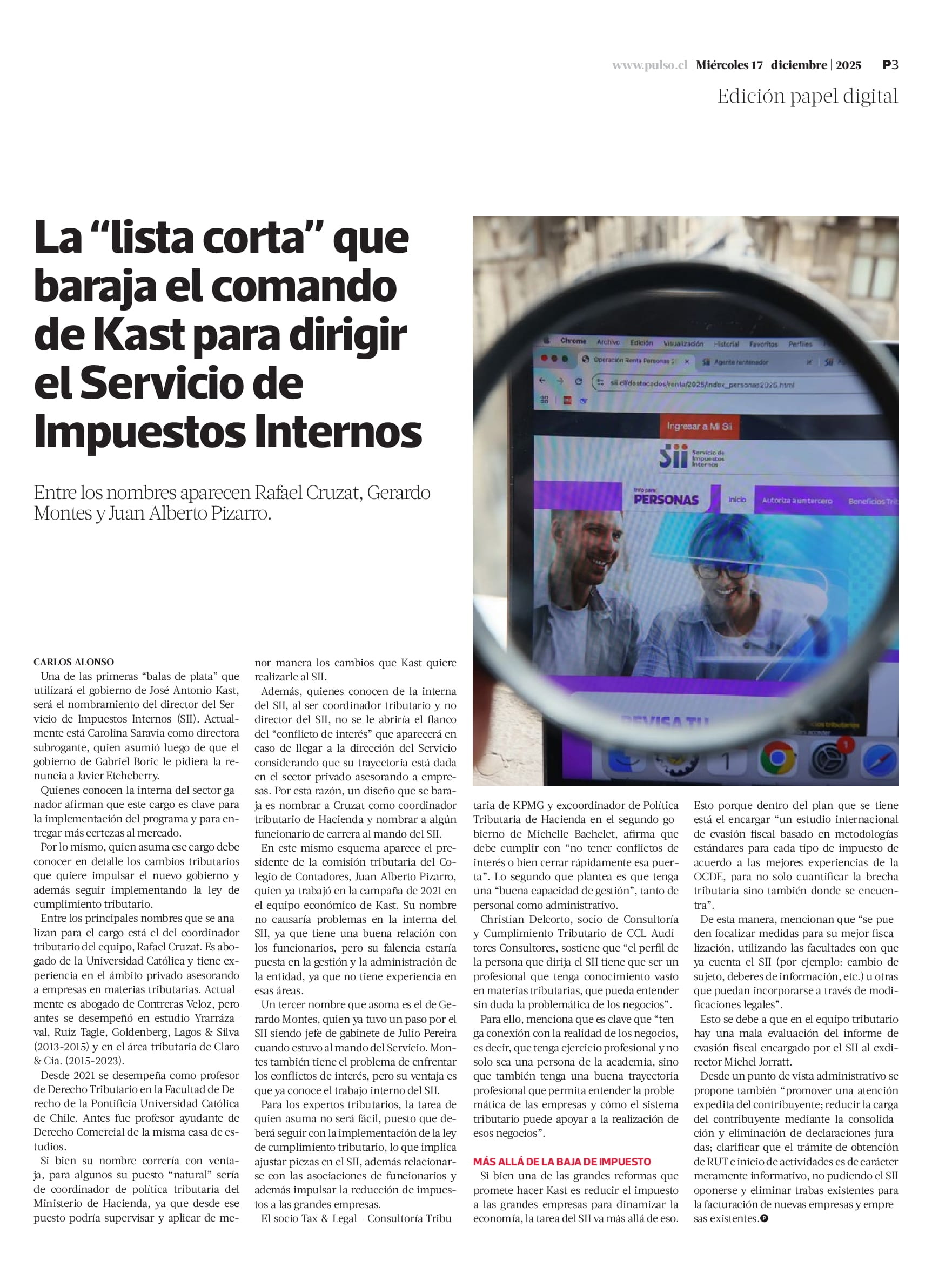
Among the names being considered are Rafael Cruzat, Gerardo Montes, and Juan Alberto Pizarro.
One of the first “silver bullets” that José Antonio Kast’s government will use will be the appointment of the Director of the Internal Revenue Service (SII). Currently, Carolina Saravia is serving as acting director, having assumed the role after the government of Gabriel Boric requested the resignation of Javier Etcheberry.
Those familiar with the internal dynamics of the winning coalition state that this position is key for implementing the government program and providing greater certainty to the market.
For this reason, whoever assumes the role must have in-depth knowledge of the tax changes the new government aims to promote and must also continue implementing the tax compliance law.
Among the main names being considered for the position is the team’s tax coordinator, Rafael Cruzat. He is a lawyer from the Pontificia Universidad Católica and has experience in the private sector advising companies on tax matters. He currently works at Contreras Veloz, but previously worked at the law firm Yrarrázaval, Ruiz-Tagle, Goldenberg, Lagos & Silva (2013–2015) and in the tax department of Claro & Cia. (2015–2023).
Since 2021, he has been a professor of Tax Law at the Faculty of Law of the Pontificia Universidad Católica de Chile. Previously, he served as an assistant professor of Commercial Law at the same institution.
Although his name appears to have an advantage, for some his “natural” role would be as Tax Policy Coordinator at the Ministry of Finance, as from that position he could oversee and implement the changes Kast intends to make to the SII.
Additionally, those familiar with the SII’s internal dynamics note that, as a tax coordinator rather than SII director, he would avoid potential “conflict of interest” concerns that could arise if he were appointed director, given his background in the private sector advising companies. For this reason, one scenario being considered is appointing Cruzat as Tax Policy Coordinator at the Ministry of Finance and naming a career official to lead the SII.
Within this same framework appears the name of Juan Alberto Pizarro, president of the Tax Commission of the Association of Accountants, who previously worked on Kast’s 2021 campaign as part of the economic team. His name would not create internal issues within the SII, as he has a good relationship with staff, but his weakness lies in management and administration, as he lacks experience in those areas.
A third name being considered is Gerardo Montes, who previously worked at the SII as chief of staff to Julio Pereira during his tenure as head of the Service. Montes also faces potential conflict of interest concerns, but his advantage is his familiarity with the internal workings of the SII.
For tax experts, the task for whoever assumes the role will not be easy, as they will need to continue implementing the tax compliance law, which involves making adjustments within the SII, engaging with employee associations, and advancing the reduction of taxes on large companies.
The Tax & Legal – Tax Consulting Partner at KPMG and former Tax Policy Coordinator at the Ministry of Finance during Michelle Bachelet’s second administration states that the person must “have no conflicts of interest or quickly resolve any such issues.” Secondly, they must have “strong management capabilities,” both in personnel and administrative matters.
Christian Delcorto, Consulting and Tax Compliance Partner at CCL Auditores Consultores, argues that “the profile of the person leading the SII must be a professional with extensive knowledge in tax matters, who can undoubtedly understand business challenges.”
To that end, he emphasizes that it is key that the individual “has a connection with the business reality—that is, professional experience—not only an academic background, but also a strong professional trajectory that allows them to understand business challenges and how the tax system can support business activity.”
Beyond tax reductions
Although one of the major reforms promised by Kast is to reduce taxes on large companies to stimulate the economy, the role of the SII goes beyond that. This is because the plan includes commissioning “an international study on tax evasion based on standard methodologies for each type of tax, according to best OECD practices, not only to quantify the tax gap but also to identify where it exists.”
In this way, they note that “measures can be better targeted for enforcement, using the powers already available to the SII (for example: change of taxpayer, reporting obligations, etc.) or others that could be incorporated through legal amendments.”
This is due to the tax team’s negative assessment of the tax evasion report commissioned by the SII from former director Michel Jorratt.
From an administrative perspective, it is also proposed to “promote efficient taxpayer service; reduce the compliance burden through the consolidation and elimination of sworn statements; clarify that obtaining a tax ID (RUT) and initiating activities is merely informative, preventing the SII from opposing it; and eliminate existing barriers to invoicing for new and existing companies.”