
The General Internal Audit Council of Government will be activated, an entity that will coordinate the audit. However, the internal review work will fall on each ministry, which has its own auditor. In the event that serious issues or inconsistencies are detected, resorting to external entities will be considered. Although there are no deadlines for obtaining results, the Executive states that work is being carried out with a sense of urgency.
Read the news at La Tercera.
It was one of the first measures announced on Wednesday night by the government of José Antonio Kast. Of the six decrees signed that evening by President José Antonio Kast, one is related to public spending, as its central focus is to carry out a “comprehensive audit” of the State.
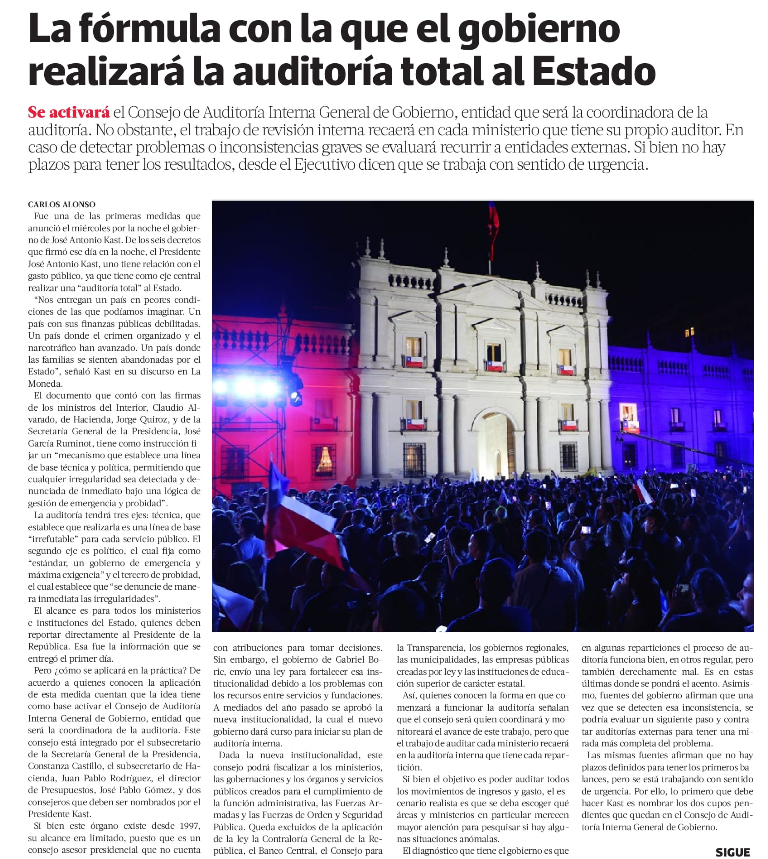
“We are being handed a country in worse condition than we could have imagined. A country with weakened public finances. A country where organized crime and drug trafficking have advanced. A country where families feel abandoned by the State,” Kast stated in his speech at La Moneda.
The document, signed by the Ministers of the Interior, Claudio Alvarado; Finance, Jorge Quiroz; and the General Secretariat of the Presidency, José García Ruminot, establishes the instruction to set up a “mechanism that creates a technical and political baseline, allowing any irregularity to be detected and reported immediately under a framework of emergency management and probity.”
The audit will have three pillars: technical, which establishes it as an “irrefutable” baseline for each public service; political, which sets as a standard “an emergency government with maximum demands”; and probity, which mandates the immediate reporting of irregularities.
The scope covers all ministries and state institutions, which must report directly to the President of the Republic. This was the information provided on the first day.
But how will it be applied in practice? According to those familiar with the implementation of this measure, the idea is based on activating the General Internal Audit Council of Government, which will coordinate the audit. This council is composed of the Undersecretary of the General Secretariat of the Presidency, Constanza Castillo; the Undersecretary of Finance, Juan Pablo Rodríguez; the Director of the Budget Office, José Pablo Gómez; and two council members to be appointed by President Kast.
Although this body has existed since 1997, its scope was limited, as it is a presidential advisory council without decision-making powers. However, the government of Gabriel Boric submitted a law to strengthen this institution due to issues with resources between public services and foundations. By mid-last year, the new institutional framework was approved, which the new government will implement to begin its internal audit plan.
Under this new framework, the council will be able to oversee ministries, regional governments, and public agencies and services created to fulfill administrative functions, as well as the Armed Forces and public order and security forces. Excluded from the law are the Office of the Comptroller General of the Republic, the Central Bank, the Council for Transparency, regional governments, municipalities, state-owned enterprises created by law, and public higher education institutions.
Thus, those familiar with how the audit will begin to operate indicate that the council will coordinate and monitor the progress of the work, but the auditing of each ministry will be carried out by the internal audit units within each agency.
Although the objective is to audit all revenue and expenditure movements, the realistic scenario is that specific areas and ministries will need to be prioritized to identify potential anomalies.
The government’s assessment is that in some agencies the audit process works well, in others moderately, and in some cases poorly. The focus will be placed on the latter. Additionally, government sources state that once inconsistencies are detected, a next step could be considered, including hiring external audits to obtain a more comprehensive view of the problem.
The same sources indicate that there are no defined deadlines for initial results, but work is being carried out with urgency. Therefore, the first step for Kast is to appoint the two remaining members of the General Internal Audit Council of Government.
The president of the Association of External Auditors, Arturo Platt, explains that “based on what we know so far and from a technical perspective, an audit of this nature should include at least stages of planning, risk assessment, review of internal control systems, execution of tests, analysis of evidence, identification of findings, and recommendations for improvement.”
He notes that “if the objective is a comprehensive review of spending and associated control mechanisms, then we are not dealing with a traditional or routine audit, but rather a broader process that may require advanced analytical capabilities, data management, traceability, and potentially specialized tools depending on its scope.”
Expert Assessment
Experts in audit processes value the initiative and the fact that it is an order issued from the Presidency of the Republic. Arturo Platt states that “what is new about this process is that it is driven and led directly by the Presidency of the Republic, and its coordination will be handled by a high-level group, which provides governance and institutional leadership.”
In this regard, the expert stated that “from a technical standpoint, the announced design appears to be oriented toward a comprehensive audit, which requires prior evaluations and determining the entities or areas to be reviewed.”
Likewise, the specialist points out that “for the type of audit required and its scope, there are professional standards, comparable experience, guidelines, and numerous methodologies to consider. There is extensive experience available on how to carry out these processes.”
Regarding the option of using external audits to enhance effectiveness, Platt indicates that “it is not always a matter of choosing between internal or external audits. The reasonable approach is to determine the most appropriate combination based on the scope of the work, timelines, risks involved, complexity of the review, and the technological capabilities required. In such cases, the participation of external audit firms can provide operational capacity, sector-specific expertise, and large-scale technological tools.”
A different view is provided by Carlos Barahona, Audit Managing Partner at CCL Auditores Consultores, who states that “if the objective of these audits is to detect irregularities, as expressed by the current government, it would be advisable for them to be conducted by external auditors, thereby ensuring transparent and independent processes, with expert professionals who provide confidence to the public in their results.”